Choose a, an or the by what your listener knows
English articles help listeners understand whether you are introducing an item or identifying a particular one. Begin with singular countable nouns and a short story. Learn the sound-based choice between a and an, then notice how the article changes when the item becomes identifiable.
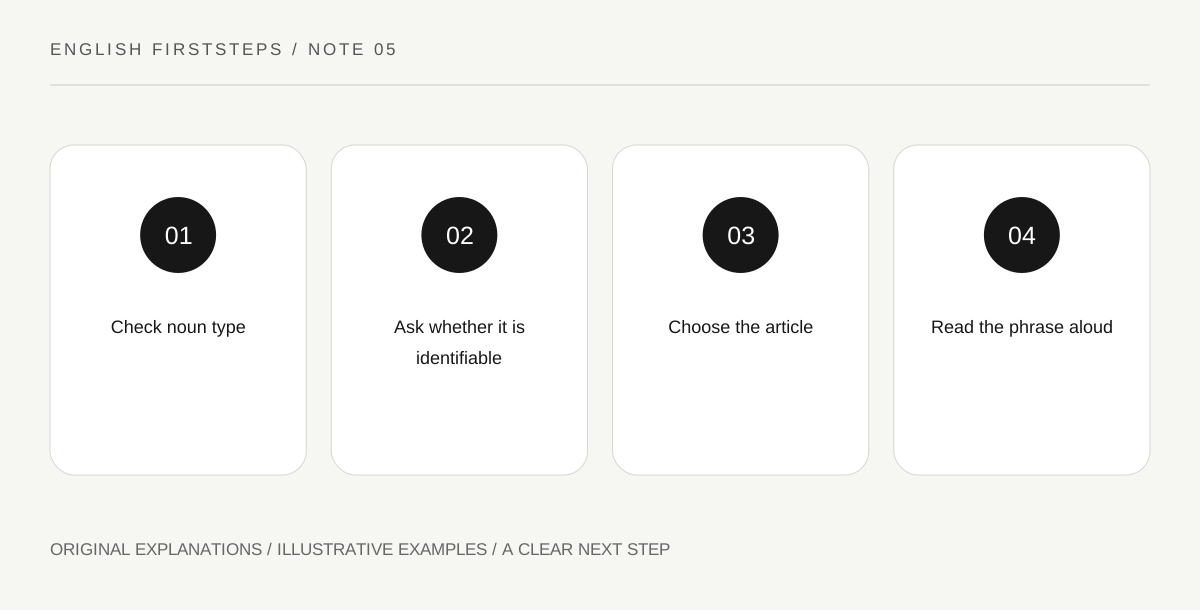
Original explanatory diagram. Read the full method and limitations below.
Introduce one item with a or an
A notebook and an umbrella introduce one item without assuming the listener knows which particular item you mean. A singular countable noun normally needs a determiner in this kind of sentence. I bought notebook is incomplete in standard English; I bought a notebook supplies the missing article.
Use three objects in a bag and reveal one at a time. Say I have a key or I have an apple. The listener does not need to identify a specific key or apple yet. This simple context makes the article’s function visible instead of presenting it as an extra word added for no reason.
Choose by sound rather than the first letter
Use an before a vowel sound and a before a consonant sound. An hour begins with a vowel sound because the h is not pronounced in that word. A university begins with a consonant-like y sound. The written first letter alone does not settle the choice.
Read the complete noun phrase aloud and listen to the word’s beginning. If you are unsure of its pronunciation, check a dictionary with audio. Do not invent a universal rule that every written h takes a or every written u takes an. The pronunciation of the particular word matters.
Use the when the item is identifiable
A short story might say, I found a notebook. The notebook has a green cover. The first sentence introduces it; the second refers to the item already mentioned. The can also work when context makes the item identifiable, such as the door in a room with one obvious door.
Make a picture with two bags and one umbrella. Ask for the umbrella, then ask for a bag. The difference is meaningful: the umbrella is uniquely identifiable in that picture, while a bag may be either one. Add a description if you mean the red bag specifically.
Do not force an article into every noun phrase
Plural and uncountable nouns can be used without an article for general meanings: Books can be useful. Water is important. This lesson does not cover every proper name or fixed expression. Learning article use involves both broad patterns and particular phrases, so a small accurate set is a better start than an absolute slogan.
For practice, write a four-sentence story about an object, mentioning it twice and adding one general sentence about similar objects. Then explain why each article appears. If you cannot explain a choice, check the intended meaning and noun type. A spellchecker may accept a sentence whose article changes the message you meant.
Illustrative lost-object story
I found a glove near a bench. The glove is blue. A woman asked about it. The woman had the other glove. The first mentions introduce a glove, bench and woman. Later mentions identify the already introduced glove and woman. In this story, the reader can track who and what each phrase refers to without needing a picture.
Practical checks
Optional checkboxes save only in this browser.
Questions that come up
Does the always mean I mentioned it before?
No. Previous mention is one way to make an item identifiable, but shared context can do the same. The light in a small room may be clear even without an earlier sentence introducing it.
Can I learn all article use from these rules?
No. These are productive beginner patterns, not a complete account of names, institutions and fixed expressions. Keep useful examples in context and consult a reference when a familiar rule does not explain a particular phrase.
References and scope
These sources support the factual background. Examples and exercises are original illustrative teaching material. References do not imply endorsement.
- British Council: Articles a, an and the — Indefinite and definite articles in elementary noun phrases.
- British Council: Countable and uncountable nouns — Noun countability, containers, some, any, much and many.