Describe a routine without adding am before every verb
The present simple helps you describe repeated activities and ordinary facts. Start with a few actions that are true for you, then describe another person’s routine. Watch what happens to the verb when the subject changes, and keep habits separate from what is happening right now.
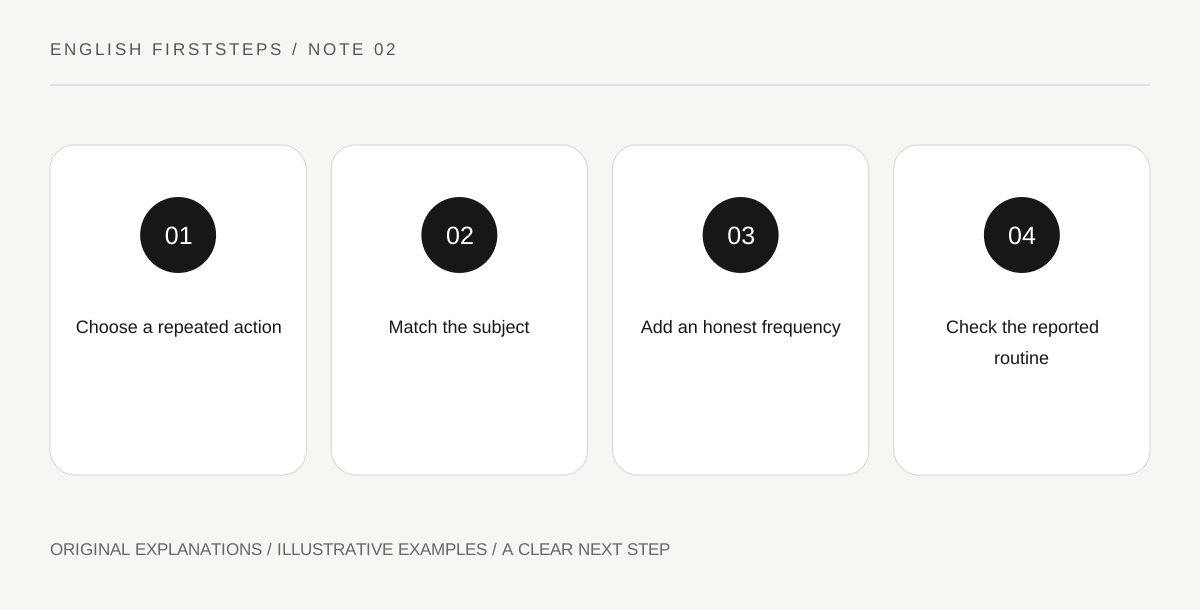
Original explanatory diagram. Read the full method and limitations below.
Build a sentence around an action
I read after dinner, we walk to class and they drink tea are present-simple statements. The verb follows the subject directly. You do not add am, is or are before read, walk or drink in these routine sentences. A familiar action phrase is easier to retrieve than a verb learned without any context.
Choose three activities and draw a small picture for each. Say a true sentence, then add a time phrase such as every morning or after work. Keep the initial vocabulary narrow so you can attend to the sentence. An elaborate daily schedule is unnecessary for learning the basic pattern.
Change the verb for he, she and it
With he, she and it, many verbs add s: she reads, he walks, it opens. Some add es, as in watches. A consonant plus y often changes to ies, as in studies. Have becomes has. These written patterns also have pronunciation details, so listen to the complete forms rather than treating the ending as silent decoration.
Write I study in one column and she studies in another. Add I have and she has, then I watch and she watches. Read the pairs aloud. The exercise should make the subject–verb relationship visible, not encourage you to attach s to every word when talking about one person.
Add frequency without claiming always
Words such as usually, often and sometimes describe frequency more honestly than always when a routine has exceptions. In a simple action sentence, usually commonly appears before the main verb: I usually read at night. With be, it commonly follows: I am usually tired. Learn those examples separately.
Make a weekly practice chart with a few activities. Choose a frequency word that matches the chart, then state the routine. If an action happened once on the chart, do not call it a permanent habit. The grammar should communicate the pattern you mean rather than make the sentence sound more impressive.
Check the meaning of the present form
The present simple is useful for habits and general facts, but it does not automatically describe an action occurring at this exact moment. I read every evening differs from I am reading now. You do not need to master both constructions in one lesson; simply notice that the intended meaning affects the form.
Interview a partner about two routines and report them with he, she or their name, using the pronouns they prefer. Let the partner confirm the report. If a sentence becomes inaccurate, identify whether you changed the subject incorrectly or misunderstood the routine itself. Grammar and information both need to remain correct.
Illustrative routine report
A fictional learner says, I study English on Tuesday and Thursday. I usually read after dinner. A partner reports, Ava studies English twice a week. She usually reads after dinner. Ava corrects one detail: she reads before dinner on Thursdays. The report can use usually because it describes a pattern with an exception rather than a rule without variation.
Practical checks
Optional checkboxes save only in this browser.
Questions that come up
Why does she study become she studies?
In the present simple, a third-person singular subject changes the verb. For a verb ending in consonant plus y, the spelling usually changes to ies. Practise the whole pair I study and she studies so the rule connects to a usable sentence.
Can I put every day at the end?
Yes. I read every day is a clear routine sentence. Time expressions can occupy other positions too, but begin with a small reliable pattern and expand after you can use it without losing the subject or verb.
References and scope
These sources support the factual background. Examples and exercises are original illustrative teaching material. References do not imply endorsement.
- British Council: Present simple — Habits, third-person forms, do and does, short answers.
- British Council: Prepositions of time — At, in and on with clock times, dates and broader periods; weekend variation.