Choose a question word that gets the information you need
A question can be grammatically tidy and still ask for the wrong information. Decide whether you need a person, place, time, reason or quantity before building it. Then use the question pattern for be, an ordinary action or a modal such as can.
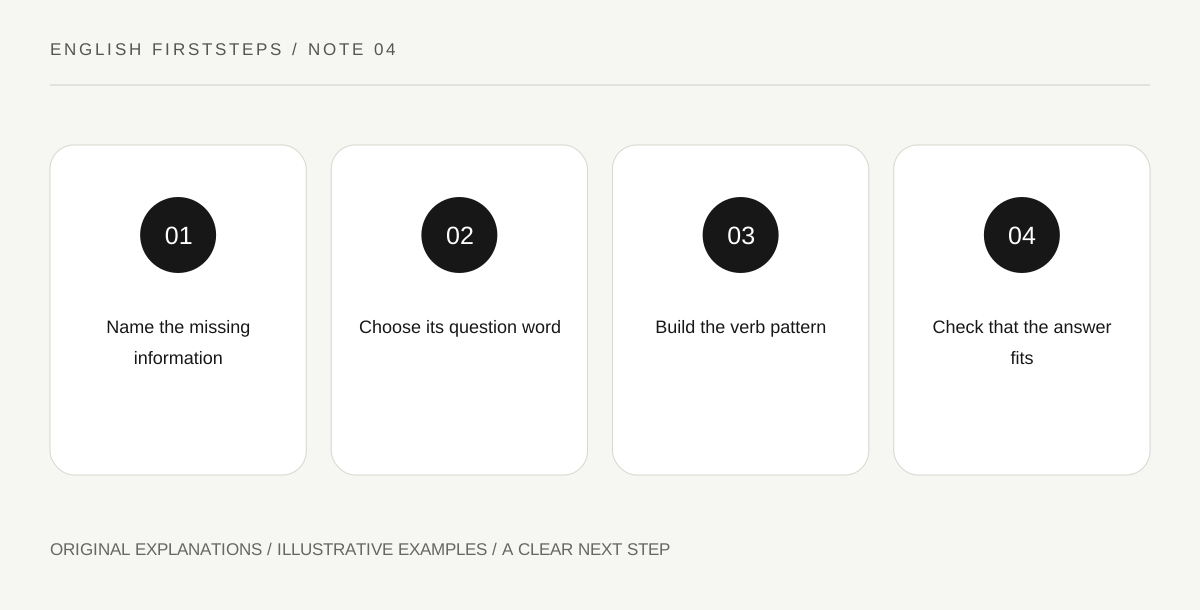
Original explanatory diagram. Read the full method and limitations below.
Start with the missing information
Where asks about place, when about time, who about a person, why about a reason and what about a thing or information more broadly. How combines with other words in useful questions such as how many and how much. The right choice depends on the answer you need, not the first English word you remember.
Write an incomplete appointment record with blank fields for place, day and hour. Ask a different question for each field. Where is the meeting? When is it? What time is it? A single broad when question may produce a day when you also need an exact hour, so follow up specifically.
Use be without adding do
The meeting is in Room Four becomes Where is the meeting? Put the question word first, then is and the subject. The visitors are at reception becomes Where are the visitors? The form of be still matches the subject even though the order has changed.
Use a picture of a small workplace with labelled rooms. Ask where a person or event is, then answer from the picture. Change one location between rounds. The task should require the listener to retrieve real information from the picture rather than repeat a memorized answer that always begins in the same place.
Use do or does for routine actions
You study in the library becomes Where do you study? She starts at nine becomes What time does she start? The main verb remains in its base form after does. Put the complete question phrase, such as what time, before the helper; do not split it around the subject.
Make a two-column activity chart with different missing details for each partner. Ask questions to complete it. If the answer gives a place when your blank needs a time, check the question word before assuming the other person misunderstood the whole sentence. The chart gives you an immediate meaning check.
Recognize a common exception without overgeneralizing
When who or what is itself the subject, the pattern can be different: Who works here? asks which person works here. Compare Who do you work with? where you is the subject and who refers to another person. Beginners do not need every exception at once, but this contrast prevents a false rule that all questions require do.
Finish by writing an answer first and asking a partner to create its question. An answer such as At six could fit several questions, so supply enough context. Discuss whether the question would genuinely produce that answer. This reverses the usual worksheet direction and reveals whether you understand the job each question performs.
Illustrative missing meeting details
A note says, The meeting is on Thursday in Room Six. A learner needs the day, place and start time. They ask When is the meeting? and Where is it? The note still lacks an hour, so they ask What time does it start? The final record contains three distinct pieces of information rather than an assumed time.
Practical checks
Optional checkboxes save only in this browser.
Questions that come up
Are when and what time identical?
They overlap, but when can invite a broader answer such as next week or on Friday. What time asks more specifically for the hour or clock time. Use a follow-up when the first answer is not precise enough.
Why is Who works here different from Where does she work?
In Who works here, who is the subject, so the ordinary subject-question pattern does not add do. In Where does she work, she is already the subject and where asks about the missing place.
References and scope
These sources support the factual background. Examples and exercises are original illustrative teaching material. References do not imply endorsement.
- British Council: Present simple, to be — Present forms of be, negatives, contractions and questions.
- British Council: Present simple — Habits, third-person forms, do and does, short answers.
- British Council: Question forms — Question-word placement, inversion, auxiliaries and subject-question exception.