Ask routine questions with do and does
Questions about ordinary activities usually need do or does in the present simple. The extra word carries part of the grammar, so the main verb stays in its base form. Practise asking and answering real questions rather than turning every statement into an identical worksheet item.
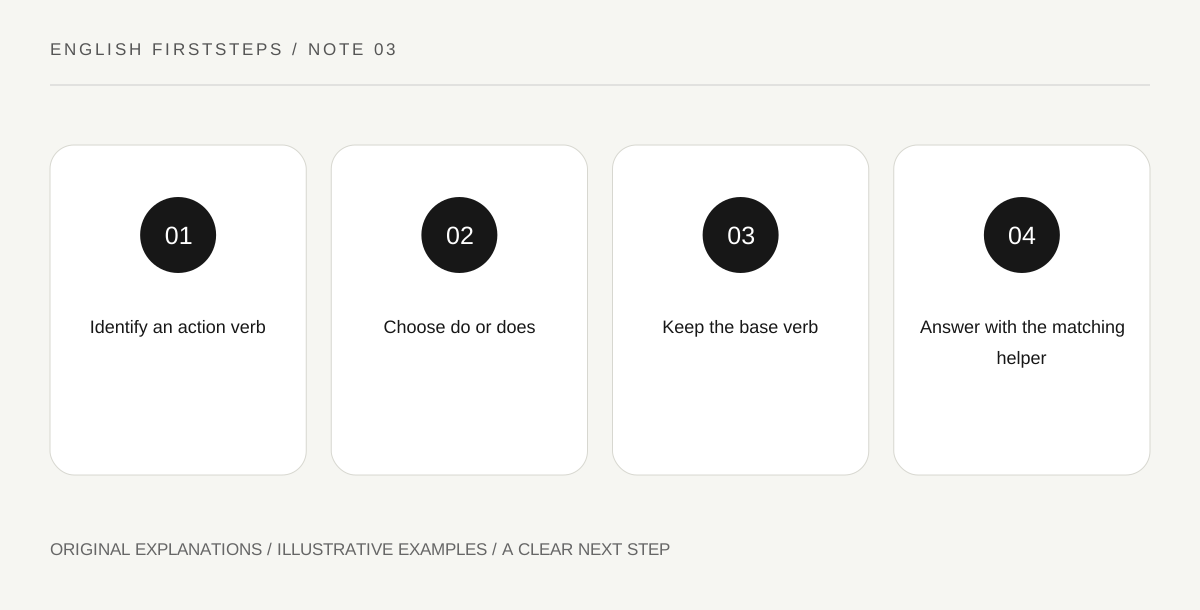
Original explanatory diagram. Read the full method and limitations below.
Add do before most subjects
You work here becomes Do you work here? They speak English becomes Do they speak English? Put do before the subject and keep the main verb after it. A yes-or-no question checks a proposition; it does not request an unrestricted answer such as a workplace name or a list of languages.
Make a small questionnaire containing three activities, such as reading, cooking and walking to class. Ask a partner each question and record yes, no or uncertain. Use ordinary low-pressure topics. A language exercise does not require questions about income, family plans or other information the person would rather keep private.
Use does with he, she and it
She works here becomes Does she work here? The s appears in does, while work returns to its base form. Does she works here is a common beginner mistake because it marks the same third-person pattern twice. The helper and the main verb must be considered together.
Write three statements with a name as the subject. Convert each to a question and underline does. Circle the base verb. Compare the pair aloud: Noor studies here. Does Noor study here? Then replace the name with two names and choose do. This makes the number of people relevant to the form.
Keep the short answer tied to the question
Do you cook? can receive Yes, I do or No, I don’t. Does she drive? can receive Yes, she does or No, she doesn’t. The short answer uses the helper from the question, adjusted to the answering subject. It does not need to repeat the entire action when the context is clear.
Practise with a partner who sometimes adds information: No, I don’t. I take the bus. The extra sentence makes the exchange more useful, but the basic answer must remain clear. Listen for the negative carefully; a missed n’t can reverse the meaning of an otherwise familiar reply.
Know when do is the wrong helper
Questions with be use a different order: Are you tired? rather than Do you are tired? Questions with can also work differently: Can you help? rather than Do you can help? These contrasts help you choose the pattern instead of adding do automatically whenever a sentence ends with a question mark.
Sort six questions into be, ordinary action and can groups. Then ask one from each group without reading. Your partner checks whether the form matches the intended meaning. If you make an error, identify the verb type first. Correcting only the word order without seeing the type makes the same mistake likely to return.
Illustrative club survey
A club wants to know who reads fiction. A learner asks, Do you read fiction? A partner replies, Yes, I do. The learner later asks about a third person: Does Jules read fiction? The answer is No, Jules doesn’t. The learner writes Jules doesn’t read fiction, keeping read in the base form after doesn’t.
Practical checks
Optional checkboxes save only in this browser.
Questions that come up
Why is Does she likes tea incorrect?
Does already carries the third-person singular marking in this question pattern. Use the base verb like after it: Does she like tea? The same principle applies after doesn’t in a negative statement.
Can I answer only yes or no?
You can when the context is clear, but short answers such as Yes, I do give useful practice and often sound more complete. Add a brief fact if it helps the conversation rather than repeating a long sentence mechanically.
References and scope
These sources support the factual background. Examples and exercises are original illustrative teaching material. References do not imply endorsement.
- British Council: Present simple — Habits, third-person forms, do and does, short answers.
- British Council: Question forms — Question-word placement, inversion, auxiliaries and subject-question exception.