Use am, is and are in a short introduction
A short introduction gives you a practical reason to learn the verb be. Connect a person to a name, place, role or feeling, then form a question. Keep these sentences separate from action sentences such as I work, which use a different pattern.
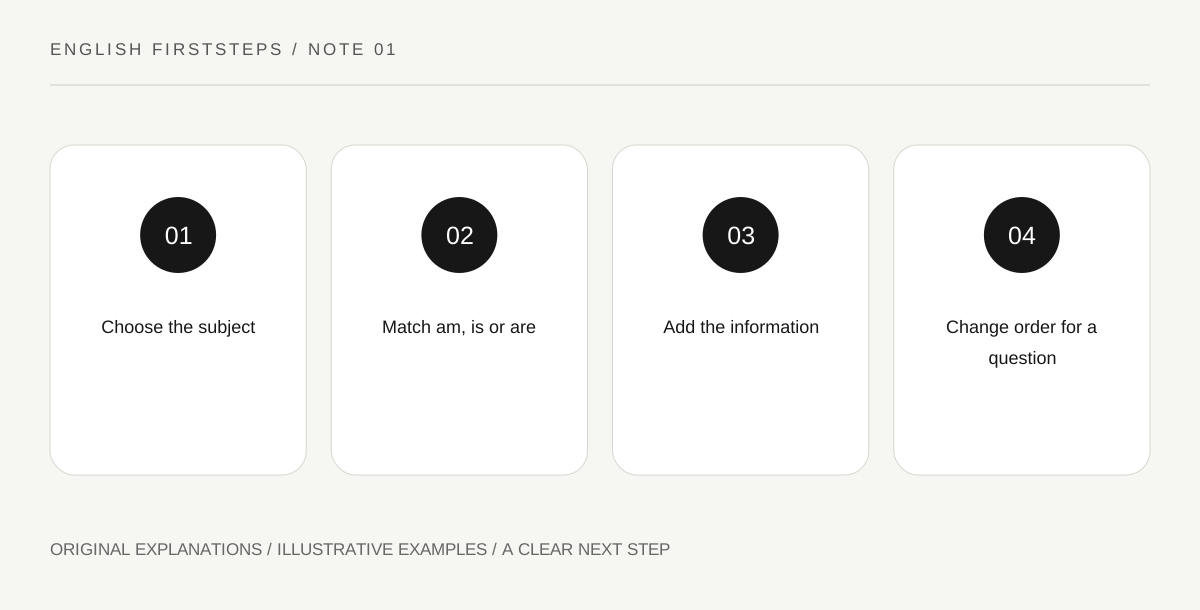
Original explanatory diagram. Read the full method and limitations below.
Match the subject to the form
Use I am, you are, we are, they are, and he, she or it is. A name usually takes is when it refers to one person: Lina is a student. Two names take are: Lina and Jo are classmates. The subject tells you which form to choose; the next noun does not decide it.
Make three identity cards with a name, city and role. Say one sentence from each field: I am Lina. I am from Lima. I am a student. Use fictional details if you prefer. Practising a few accurate sentences gives the forms a purpose beyond memorizing a verb table.
Hear and use common contractions
In ordinary speech, I am often becomes I’m, you are becomes you’re, and she is becomes she’s. The contraction is not a different meaning. Learn to recognize both full and short forms so a familiar sentence does not sound new when a speaker connects the words.
Write a full sentence and its contracted version beside it, then listen to a model. Say each version comfortably without rushing. In clear explanatory writing, either can be appropriate depending on tone. Do not add an apostrophe merely because a word ends in s; the mark represents missing letters in these contractions.
Make a negative by adding not
I am not a teacher and she is not tired show the basic negative pattern. I’m not, she isn’t and they aren’t are common spoken forms. Standard beginner English uses I’m not rather than I amn’t. Keep the negative attached to be rather than inserting don’t into this pattern.
Give your partner one incorrect detail from a fictional identity card. They correct it with a negative and a positive: I’m not from Rome. I’m from Lima. This creates a real reason to use not and checks whether both people understood the information rather than simply copied a sentence.
Move be before the subject to ask
You are a student becomes Are you a student? She is from Lima becomes Is she from Lima? The order changes without adding do. For a short positive answer, say Yes, I am or Yes, she is. A positive short answer does not normally end in the contraction I’m or she’s.
Finish with a two-person interview. Ask two questions, record the answers, and introduce your partner using is. Then let your partner correct any mistaken detail. This moves from I to another subject and tests the form in a new position, while keeping the content simple enough to check.
Illustrative identity correction
A practice card says Mina, Seoul, designer. A partner asks, Are you a teacher? Mina replies, No, I’m not. I’m a designer. The partner then writes, Mina is a designer. Mina checks the sentence and adds, I’m from Seoul. The group has used statement, negative, question and third-person forms around the same clear information.
Practical checks
Optional checkboxes save only in this browser.
Questions that come up
Can I say I am work here?
No. Work is an action verb in that sentence, so say I work here. Be connects the subject to an identity, description or location in this lesson; it does not belong before every present-tense verb.
Is Yes, I’m a complete short answer?
Use Yes, I am when the answer ends there. I’m can begin a longer statement, such as I’m a student, but the contraction is not normally used alone at the end of that positive short answer.
References and scope
These sources support the factual background. Examples and exercises are original illustrative teaching material. References do not imply endorsement.
- British Council: Present simple, to be — Present forms of be, negatives, contractions and questions.
- British Council: A1 speaking — Contextual speaking practice, introductions, suggestions and checking understanding.