Order at a café and handle the next question
Saying a drink name is only one part of ordering. The server may ask about size, temperature or whether you are staying. Learn a compact opening, recognize common follow-ups and confirm your order before treating the total as the end of the conversation.
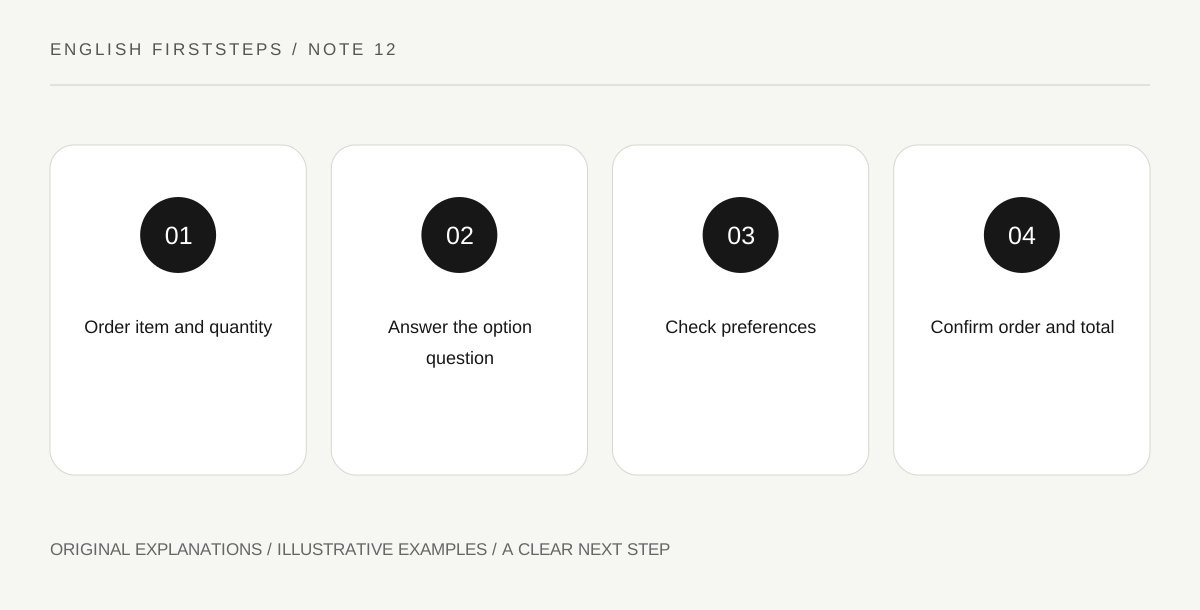
Original explanatory diagram. Read the full method and limitations below.
State the item and quantity
Can I have a small tea, please? combines a request with an item and size. I’d like two coffees, please is another useful form. Learn your preferred order as a whole phrase, then practise changing the quantity or item. A completely fixed sentence is less useful when the menu differs.
Choose a practice menu with three drinks and two snacks. Give each item a clearly illustrative price. The customer orders without showing their choice card, and the server writes it down. Compare the written order afterward. This tests whether the words communicated an actual item rather than simply sounded like a café conversation.
Recognize common option questions
Small or large? asks about size. Hot or iced? asks about temperature or preparation. For here or to go? is common in American English; eat in or take away is common in British contexts. Businesses use different expressions, so recognize the purpose as well as one exact wording.
Answer with the relevant choice rather than a general yes. If you hear unfamiliar sizes, ask the server to show them. A label such as regular is not a universal measurement. Select the actual serving you want rather than demonstrate that you remember a particular business’s size word.
Add preferences carefully
Without ice or with milk expresses a simple preference. Add one change at a time and check whether it is possible for that item. A drink may already contain an ingredient. A short customization phrase cannot establish detailed dietary information or preparation procedures.
Use a role-play in which one request is unavailable. The server explains and offers a different option. The customer can accept, ask another question or decline. This teaches flexible listening and makes clear that polite language does not require purchasing an unsuitable item merely to finish the exercise.
Check the order separately from payment
Before paying, check item numbers, sizes and important preferences. A plausible total does not prove the order is correct. If a detail is wrong, use a concise correction such as Sorry, one tea, not two. Keep the tone calm and identify the specific change.
After the correction, confirm the total with the currency understood. Real prices vary and change, so classroom amounts stay labelled as examples. Let the server make one deliberate error. The customer notices it, corrects it and confirms the new written order before finishing.
Illustrative takeaway order
A learner orders one small tea and one plain sandwich from a fictional menu. The server asks, Eat in or take away? The learner answers, Take away, please. The server repeats two teas, so the learner says, Sorry, just one tea. The corrected order is checked before the illustrative total is read. The follow-up questions matter as much as the opening.
Practical checks
Optional checkboxes save only in this browser.
Questions that come up
Can I say a coffee if coffee is uncountable?
Yes. In a café, a coffee commonly means one serving or order. The word can describe the drink generally or a countable serving in context. Learn both uses through complete examples.
Is a short phrase enough for an allergy?
No. Serious dietary needs require accurate ingredient and preparation information, which a beginner phrase may not convey. Use reliable written information and appropriate assistance rather than interpreting a short reply as a guarantee.
References and scope
These sources support the factual background. Examples and exercises are original illustrative teaching material. References do not imply endorsement.
- British Council: Countable and uncountable nouns — Noun countability, containers, some, any, much and many.
- British Council: A1 speaking — Contextual speaking practice, introductions, suggestions and checking understanding.
- British Council: A1 listening — Elementary listening situations including cafés, directions, work and booking.