Ask directions and repeat the turning point
Direction words become useful when they connect to a visible place and a sequence. Learn a polite question, a small set of movement instructions and a way to confirm the turn. A familiar-sounding route still needs to lead to the exact destination you intended.
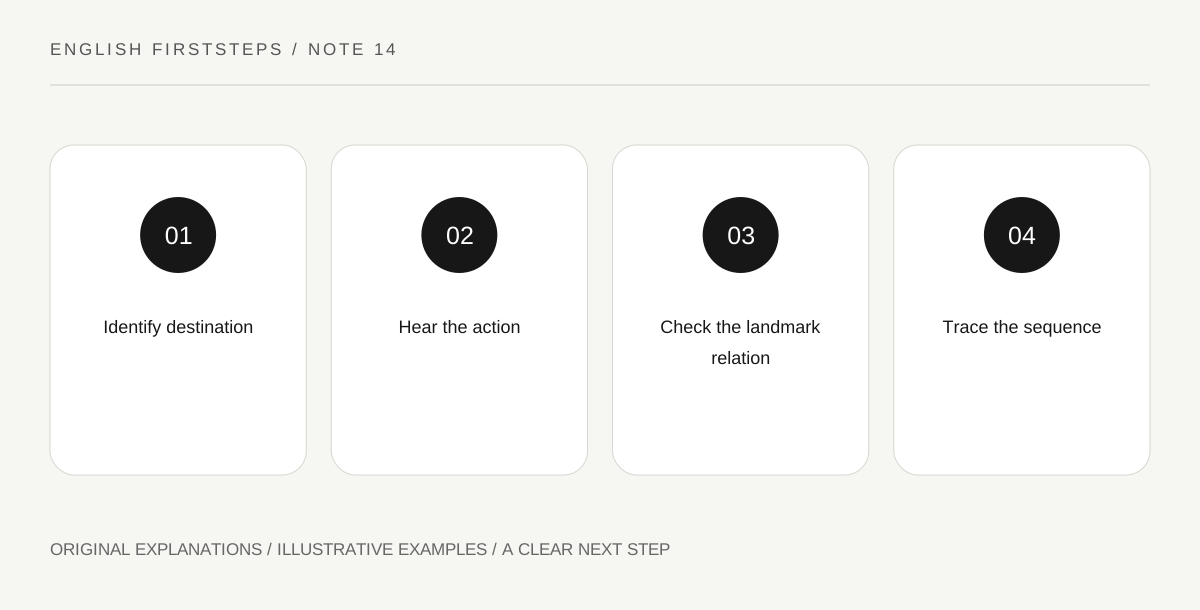
Original explanatory diagram. Read the full method and limitations below.
Ask about a recognizable destination
Excuse me, where is the library? is a clear beginner question. If the destination has a specific name, show it on a map or in writing. A general word such as station may be insufficient in a place with several stations or multiple entrances.
Practise with a map containing a library, café, entrance and office. Give each place a distinct label. Identify the destination before the other partner gives directions. This prevents a long accurate route to the wrong building and gives written names a useful role in spoken interaction.
Separate location from movement
It’s next to the café describes a position. Go straight and turn left describe actions. Across from and between relate places to one another. Learn a few phrases with pictures rather than a long list of translations whose differences remain abstract.
Place a token at the starting point and move it only when an action is given. For a location phrase, point to the relation without moving. Then combine one movement instruction with one landmark, keeping the route short enough that the listener can explain it afterward.
Attach a turn to the correct landmark
Turn right at the bank differs from turn right after the bank. Recognizing right is not enough if you miss the point where the turn happens. Ask, At the bank? or After the bank? to confirm. A focused question often resolves more than repeating the entire route.
Make two map versions with a junction before and after a café. The speaker gives a route, and the listener draws an arrow. Compare arrows. Identify whether a mismatch concerns left versus right, the landmark or the sequence word. Each needs a different correction.
Check the route before relying on it
Written signs, current access restrictions and the actual environment can change what is possible. A language exercise teaches comprehension, not live navigation or a guarantee of safety. When a route remains unclear, use an appropriate map, official information or further assistance instead of walking on a guess.
End the practice by having the listener summarize the first two steps and point to the destination. The speaker corrects a mismatch before the token moves. A drawing or action can demonstrate understanding, so the beginner does not need a long explanation to prove they followed the directions.
Illustrative campus route
A learner asks for the study centre on a fictional campus. The partner says, Go straight, then turn left after the café. The learner points to the junction before the café and asks, Here? The partner corrects the point, and the learner traces the route again. The word left was understood; the missing detail was after.
Practical checks
Optional checkboxes save only in this browser.
Questions that come up
Should I pretend to understand to avoid bothering someone?
No. A brief clarification can prevent a larger misunderstanding. Ask about the specific missing part, or use a map if the conversation remains difficult. A polite nod should not substitute for comprehension.
Is opposite identical to across from?
Both can describe facing positions in many contexts, with regional and contextual preferences. Learn a clear model with a picture and check the actual relationship instead of assuming each phrase has one identical translation.
References and scope
These sources support the factual background. Examples and exercises are original illustrative teaching material. References do not imply endorsement.
- British Council: Question forms — Question-word placement, inversion, auxiliaries and subject-question exception.
- British Council: Prepositions of place — In, on and at in elementary location descriptions.
- British Council: A1 listening — Elementary listening situations including cafés, directions, work and booking.
- British Council: Checking understanding — Requests for repetition and checks of understood information.