Ask for a different clothing size and describe the fit
Clothing shopping gives beginners a practical reason to use this, these, size words and comparisons. Keep the item clear, distinguish a request from a purchase decision and describe what does not fit. Use the language to inspect the garment rather than rely on its label alone.
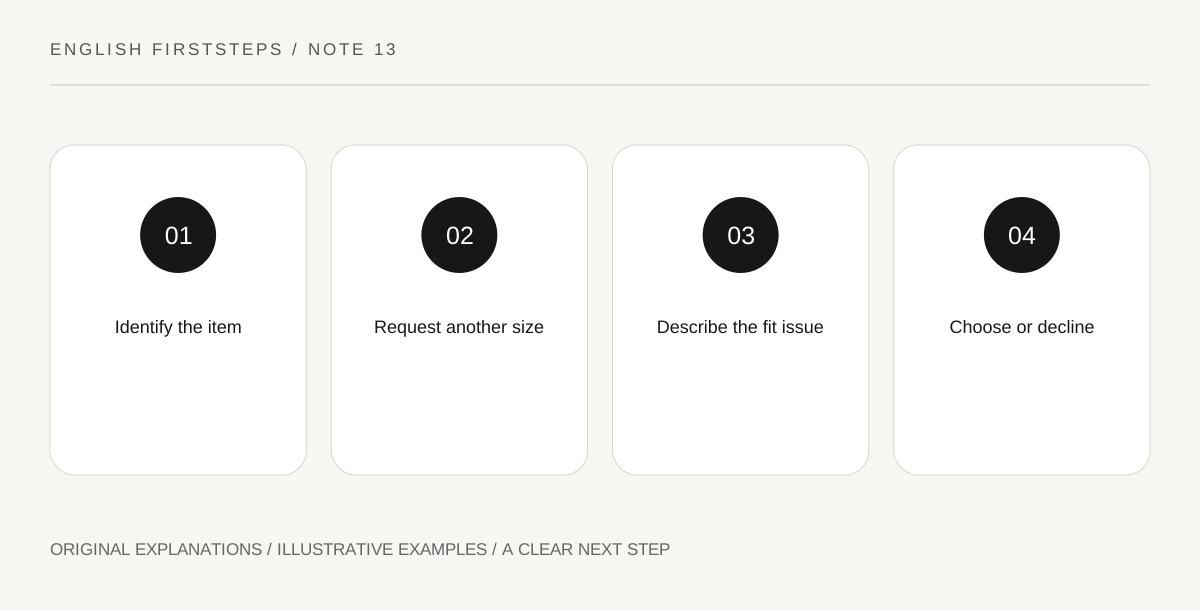
Original explanatory diagram. Read the full method and limitations below.
Identify one item or a pair
This shirt refers to one nearby shirt; these shoes refers to a plural pair. How much is this shirt? and How much are these shoes? match the noun’s number. Point clearly when similar items are present so the assistant answers about the intended garment.
Make a practice display with a shirt, jacket and shoes. Ask the price of one item without naming its picture number. The assistant repeats the item before answering. This checks the reference as well as is or are, avoiding correct grammar about different objects.
Request an actual size alternative
Do you have this in a smaller size? and Do you have a larger one? are useful patterns. A size label does not have identical dimensions across every brand. Use the language to request the actual alternative, then evaluate it with relevant measurements or an appropriate try-on.
Give the assistant a stock card showing which sizes are available. The customer asks, and the assistant sometimes says no. Include a different colour or style as an optional alternative. The customer can decline; the task exchanges information rather than ensuring a sale.
Describe one concrete fit problem
It’s too small, the sleeves are too long and these feel tight describe different problems. Too means beyond what is suitable for the purpose; very merely intensifies a description. A very long scarf may be desirable, while sleeves that are too long present a fit problem.
Use a drawing showing an oversized sleeve and a short hem. Match each problem to a sentence, then request an appropriate alternative. Avoid vague judgments about a person’s body. The fit relationship concerns this garment and the wearer’s preference, not a rule that a body must have a particular shape.
Close the exchange clearly
I’ll take this one signals a purchase choice. I’ll think about it or No, thank you lets you decline. Before buying, check the particular item, price and relevant store terms through current information. A language lesson cannot establish a shop’s return rules or stock availability.
Finish by having the assistant present two similar garments, only one matching the agreed size. The customer identifies the correct one and chooses to buy or leave. This final reference check matters: a successful request can still be followed by the wrong item.
Illustrative jacket exchange
A learner points to a jacket and asks, Do you have this in a smaller size? The assistant offers one. The learner says, The sleeves are still too long, and asks about another style. The alternative costs more in the fictional price list, so they check the price and decide to think about it. No purchase is required for a successful exchange.
Practical checks
Optional checkboxes save only in this browser.
Questions that come up
Are large and larger the same request?
No. Large can name a labelled size, while larger compares with another item. A larger garment might have a different label depending on the range. Point to the reference item and clarify the alternative you need.
Must I explain why I am not buying?
No. A brief polite decline is enough in many ordinary interactions. Practise a clear closing so you do not feel forced to invent a long excuse or purchase an unsuitable item.
References and scope
These sources support the factual background. Examples and exercises are original illustrative teaching material. References do not imply endorsement.
- British Council: Present simple, to be — Present forms of be, negatives, contractions and questions.
- British Council: Question forms — Question-word placement, inversion, auxiliaries and subject-question exception.
- British Council: Comparative adjectives — Comparative formation, irregular forms and than.
- British Council: Shopping for clothes — Elementary shop interaction, clothing requests and follow-up details.