Ask for help or permission with can
Can forms useful beginner requests without a complicated verb change. Learn the difference between asking someone to act and asking permission for yourself. Then make the request specific enough to answer, and listen for conditions rather than treating every polite reply as a simple yes.
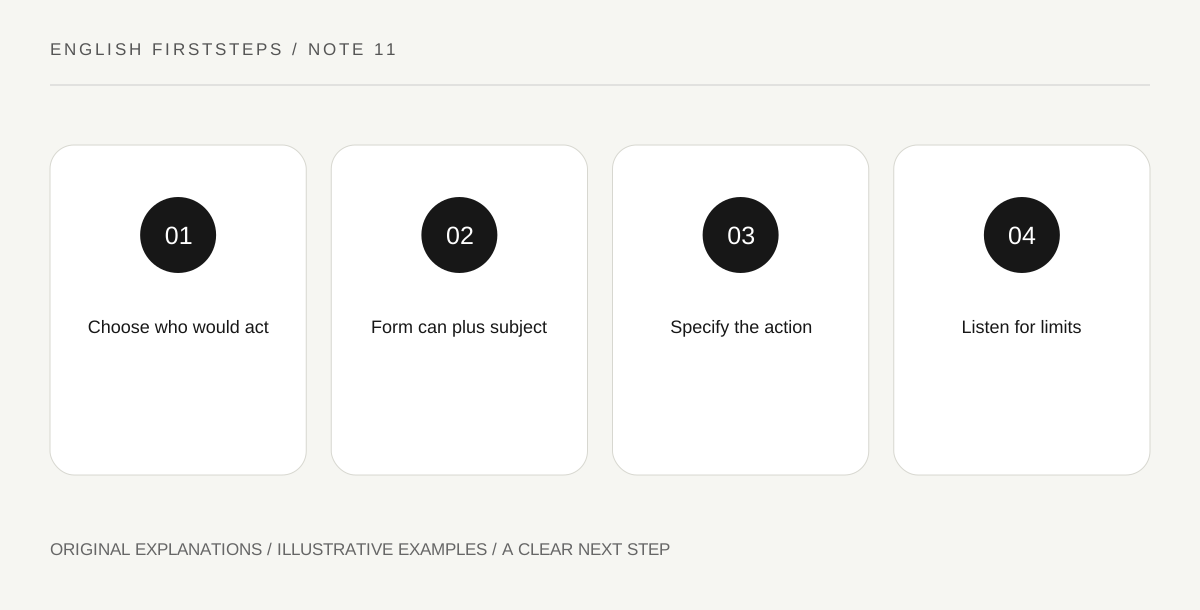
Original explanatory diagram. Read the full method and limitations below.
Put can before the subject
Can you help me? asks the listener to help. Can I sit here? asks permission for your own action. In both, can comes before the subject and the next verb stays in its base form. Do not add do or an s ending: Can she help? is the pattern.
Learn requests linked to real settings, such as Can you open the window? or Can I use this chair? Say the whole phrase with a clear object. Can you do it? may be grammatical but leaves the listener guessing if the action has not been established.
Make the action and object clear
Help can refer to many tasks. Can you help me find Room Five? gives the listener a concrete job. When the action contains unfamiliar vocabulary, point to a map or item while speaking. Precision often makes a request easier to answer than adding several extra politeness words.
Use a picture task with a door, chair and map. One partner requests an action, and the other identifies the object before acting. Include similar objects so that the blue chair becomes necessary. If the listener chooses incorrectly, revise the reference rather than repeat the same vague words.
Choose courteous wording for the setting
Please can appear in a request, and could is another common polite form worth learning as a chunk. Politeness also depends on tone, setting, relationship and whether the request is reasonable. No single word makes a demanding or intrusive request automatically considerate.
Practise two versions for different situations. For a friend, Can you pass the pen, please? may fit. In a service setting, Could you help me with this form, please? may be useful. You do not need every modal meaning to learn a small courteous expression accurately.
Hear and respect the answer
A reply may be yes, no, not now or yes with a condition. You can sit here, but we need the chair at two establishes a limit. Ask a follow-up if the condition is unclear. A request invites an answer; it does not establish agreement by itself.
For a role-play, give the responding partner a card saying available, unavailable or available later. The requester responds and chooses the next step. This creates genuine listening work. The exercise is complete when both people understand what help is available, even when the answer is no.
Illustrative classroom request
A learner asks, Can I use this chair? The partner replies, Yes, but only until the next class starts. The learner asks, What time does it start? After hearing ten thirty, they confirm the limit. Another learner asks, Can you help me find the library? The different subjects identify who would perform each action.
Practical checks
Optional checkboxes save only in this browser.
Questions that come up
Is Can you always a question about ability?
No. In context it often functions as a request, such as Can you pass the salt? The listener understands the practical purpose. Learn the phrase in a situation rather than assigning can only one meaning.
Does adding please make any request polite?
No. Wording is only part of politeness. The situation, tone, burden and freedom to decline also matter. Keep the request reasonable and respond to the answer instead of repeating it until the person agrees.
References and scope
These sources support the factual background. Examples and exercises are original illustrative teaching material. References do not imply endorsement.
- British Council: Question forms — Question-word placement, inversion, auxiliaries and subject-question exception.
- British Council: A1 speaking — Contextual speaking practice, introductions, suggestions and checking understanding.
- British Council: Checking understanding — Requests for repetition and checks of understood information.