Compare two options with clearer, cheaper and more convenient
Comparatives help you explain why one option suits a purpose better than another. Learn the adjective form, name what you are comparing, and support the comparison with a concrete observation. A grammatical sentence should not turn a personal preference into an unsupported universal claim.
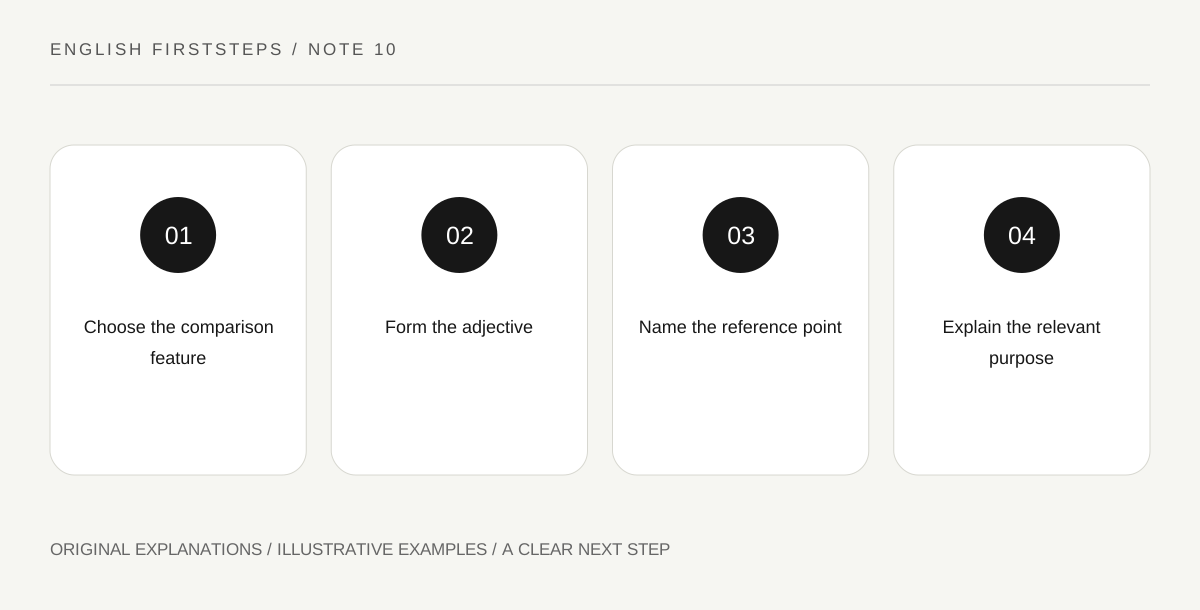
Original explanatory diagram. Read the full method and limitations below.
Add er to many short adjectives
Small becomes smaller and cheap becomes cheaper. An adjective ending in e often adds r, as in large to larger. Some short forms double a final consonant, as in big to bigger. These patterns help with spelling, but listen to the complete word so the ending becomes part of your spoken vocabulary too.
Compare two drawn boxes with different dimensions. Say The blue box is bigger than the red box. Then reverse the comparison using smaller. The objects have not changed; you have changed the direction of the relationship. This makes the grammar meaningful instead of attaching er to an isolated adjective list.
Use more with many longer adjectives
More convenient and more expensive are common comparative phrases. Do not normally combine more with an er form, as in more cheaper. Some two-syllable adjectives allow variation, so a dictionary or grammar reference helps when a form is unfamiliar. A simple syllable slogan does not cover every adjective.
Choose three useful adjectives for a real task, such as quiet, convenient and expensive when discussing two study cafés. Learn each comparative as a complete phrase. You can then concentrate on the information you want to convey instead of trying to invent a form under conversational pressure.
Remember common irregular forms
Good becomes better and bad becomes worse. Far has comparative forms farther and further, with usage depending on context and variety. Start with better and worse in familiar situations. They are common enough that learning them as separate words is more useful than trying to derive them from the regular spelling patterns.
Ask better for what before making a broad claim. A room may be quieter but farther from the station. An option can suit one person’s purpose while being less suitable for another. The comparative form describes a relationship; it does not eliminate the need to specify the dimension that matters.
Use than to name the reference point
This route is shorter than the river route identifies what shorter is compared with. Without a reference point, the listener may have to guess. In context the second option can be understood, but a beginner exercise benefits from naming both so the relation is easy to check.
Make a small table with two options and two measured or clearly described features. Write one comparison for each feature and one preference sentence beginning For me. Label invented numbers as illustrative. The exercise separates a supported comparison from a personal choice and avoids presenting fictional prices or travel times as current facts.
Illustrative study-space comparison
A practice table gives Room A four chairs and a noisy corridor; Room B six chairs and a quiet corridor. A learner says, Room B is larger and quieter than Room A. It is more convenient for our six-person group. The convenience claim is tied to the group’s size rather than presented as a fact about every possible user.
Practical checks
Optional checkboxes save only in this browser.
Questions that come up
Is more better correct in ordinary beginner English?
Use better by itself as the comparative of good. More better marks the comparison twice in standard usage. You can intensify it with a suitable phrase such as much better when that meaning is justified.
Does cheaper mean better value?
No. Cheaper compares price, while value depends on what the item provides for the intended purpose. Keep the language precise: state the price comparison first, then explain any preference separately.
References and scope
These sources support the factual background. Examples and exercises are original illustrative teaching material. References do not imply endorsement.
- British Council: Comparative adjectives — Comparative formation, irregular forms and than.