Count apples, measure rice and ask how much
English countability describes how a noun is used, not whether a real object could ever be counted. Apples take plural forms easily; rice usually needs a quantity or container expression. Learn the noun’s pattern with a useful phrase, then choose how many or how much accordingly.
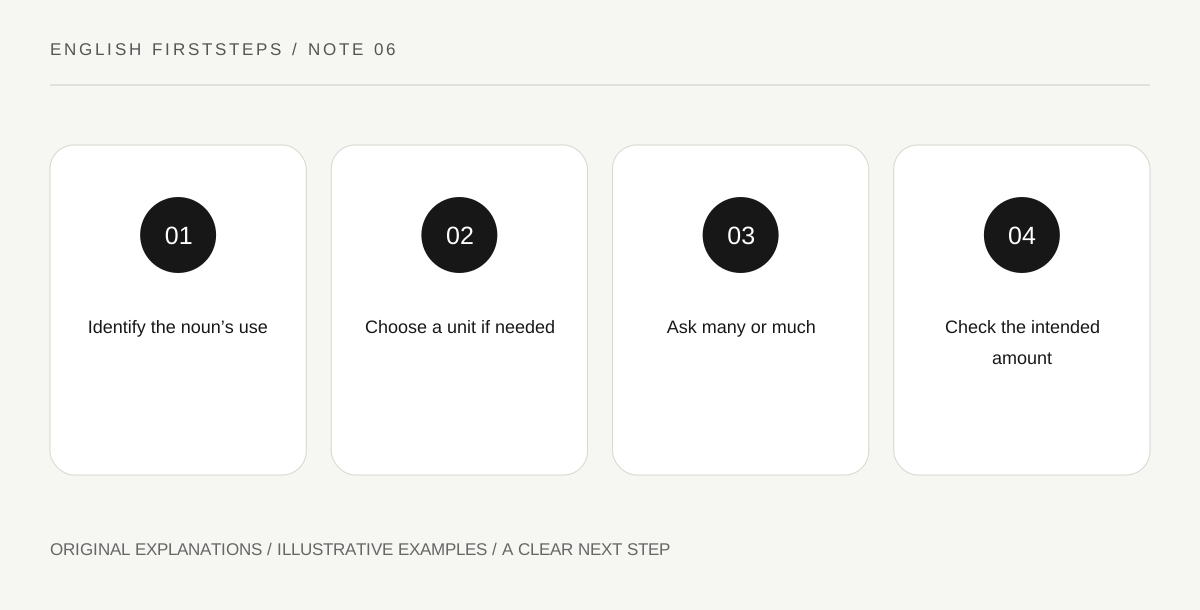
Original explanatory diagram. Read the full method and limitations below.
Learn nouns with a usable quantity
One apple and three apples show a countable pattern. Rice and water commonly behave as uncountable nouns, so a rice or three waters is not the ordinary basic way to describe their general amounts. A grain of rice, a bowl of rice and a bottle of water give countable units.
Create a practice shopping list with apples, bread, milk and eggs. Add a useful unit where needed, such as a loaf of bread or a carton of milk. This is more practical than memorizing a noun under a label without learning how to request it in an actual sentence.
Match the question to the noun phrase
How many apples asks for a number of countable items. How much rice asks for an amount of an uncountable noun. How many bowls of rice counts the bowls. The real food has not changed; the grammatical unit has. Look at the complete phrase before choosing the question.
Put a bowl, a bottle and loose apples on a practice table. Ask one question about the contents and another about the containers. A partner answers with an appropriate unit. If they reply three to how much rice, ask three what. This reveals the missing measurement rather than treating every number as a complete answer.
Use some and any with context
Some often appears in positive statements: We have some rice. Any often appears in negatives and ordinary availability questions: We don’t have any rice. Do we have any rice? Offers and requests commonly use some, as in Would you like some water? The positive-versus-question distinction is a useful start with important exceptions.
Make a cupboard picture with present and absent items. State what is there, ask about an item, and answer negatively when appropriate. Then offer a present item using some. The change in purpose helps you remember why some can appear in a question instead of incorrectly replacing it with any every time.
Notice nouns whose meaning changes the pattern
Coffee can refer to the drink as a substance or, in a café context, to a serving. Two coffees may mean two cups or orders of coffee. This does not make countability meaningless; it shows that meaning and context matter. Start with the ordinary beginner use and add other uses when you meet them.
For a final exercise, rewrite five vague shopping requests with clear quantities. Compare a little milk, two bottles of milk and some milk. Each can be grammatical while giving a different level of precision. Choose the phrase that lets the listener provide the amount you actually intend.
Illustrative picnic list
A learner writes three apples, two bottles of water and some bread. A partner asks How much bread? The learner changes it to one loaf of bread because the picnic needs a specific purchase. They ask How many bottles of water? rather than How much bottles. The container is countable even though water itself usually takes an uncountable pattern.
Practical checks
Optional checkboxes save only in this browser.
Questions that come up
Why is advice usually uncountable?
Countability is a convention of English usage. Say some advice or a piece of advice in ordinary contexts, rather than an advice. Learn such nouns in useful phrases instead of assuming their pattern will match your first language.
Is two coffees always wrong?
No. In a café it commonly means two servings. In a basic lesson about the drink as a substance, coffee is uncountable. The intended sense and setting explain the difference.
References and scope
These sources support the factual background. Examples and exercises are original illustrative teaching material. References do not imply endorsement.
- British Council: Countable and uncountable nouns — Noun countability, containers, some, any, much and many.
- British Council: A1 listening — Elementary listening situations including cafés, directions, work and booking.