Describe what a room has with there is and there are
There is and there are introduce something that exists in a place. They are useful for describing a room, checking facilities or asking what is available. Keep them separate from a sentence that tells you where an already identified object is located.
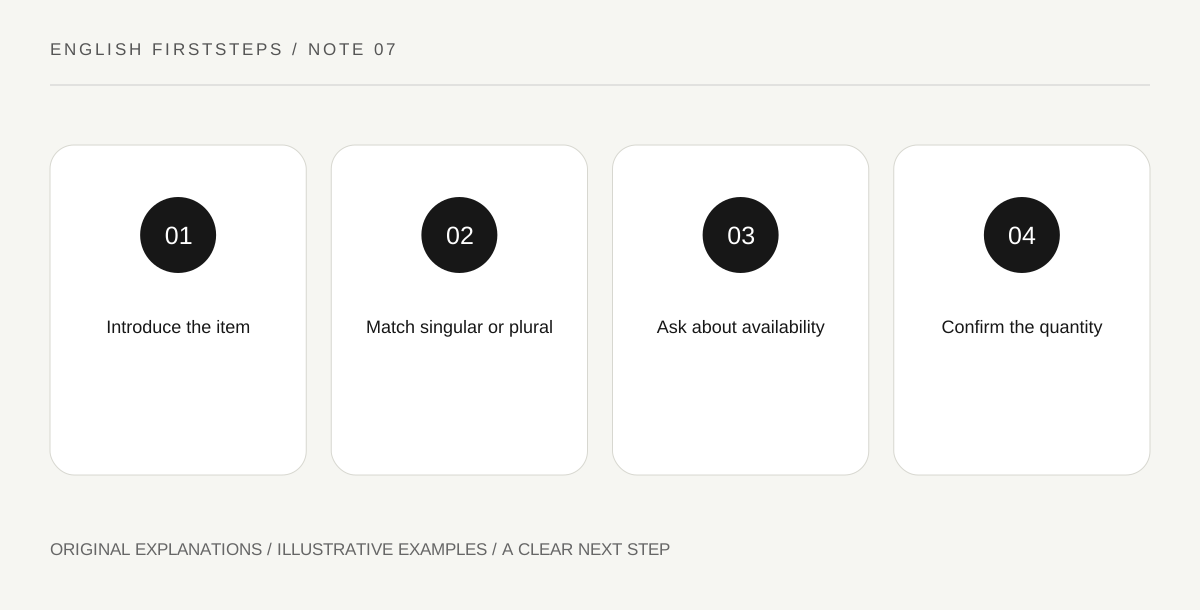
Original explanatory diagram. Read the full method and limitations below.
Introduce an item or group
There is a desk in the room introduces one desk. There are two chairs introduces a plural group. The noun phrase determines is or are in this basic pattern. The word there is part of the construction; it does not by itself point to a particular corner of the room.
Look at a simple room drawing and list three things you can see. Say one singular sentence and one plural sentence. Then cover the drawing and ask a partner to sketch from your description. A correct sketch demonstrates whether the number and item were understood, rather than merely whether your sentence sounded familiar.
Distinguish introducing from locating
There is a lamp on the desk tells the listener that a lamp is present. The lamp is on the desk locates an identified lamp. Both may describe the same picture, but they organize information differently. A beginner can use the first to introduce an object and the second when talking about it again.
Try a two-sentence description: There is a cupboard in the room. The cupboard is beside the door. The second sentence does not need to introduce another cupboard. This small sequence connects grammar to the way a listener builds a mental picture from new and then familiar information.
Ask whether something is available
Is there a desk? asks about one possible desk. Are there any chairs? asks about a plural group. Is there any water? uses a singular form with the uncountable noun water. Answers include Yes, there is and No, there aren’t. A positive short answer does not end with there’s.
Give one partner a facility checklist and another a room picture. Ask questions to complete the checklist without showing the picture. Include an absent item so that the exercise requires listening to negatives. Availability should come from the answer, not the assumption that every worksheet question must receive yes.
Use clear negatives and exact quantities
There isn’t a printer and there aren’t any windows give clear negative information. There is no water can emphasize absence. A quantity such as three chairs is often more useful than some chairs when planning a meeting. Match the precision to the purpose of the description.
In informal speech you may hear there’s before a list or plural expression. Recognize that variation while practising the standard singular–plural distinction in your own beginner writing. The aim is to understand real speech and produce a dependable form, not correct every casual speaker during a practical conversation.
Illustrative study-room check
A learner needs a study room for three people. They ask, Is there a table? Are there three chairs? The partner answers, There is a table, but there are only two chairs. The learner marks the room as unsuitable for that plan. Understanding the quantity matters more than treating the first yes as confirmation of every facility.
Practical checks
Optional checkboxes save only in this browser.
Questions that come up
Why can’t I say Yes, there’s as the whole answer?
The contraction there’s normally needs following information, as in There’s a desk. In a complete short answer, use Yes, there is. Negative short answers can use forms such as No, there isn’t.
Should I use it is instead?
It is can describe or identify something already established. There is introduces the presence of something. Compare There is a chair with It is blue after the chair is known.
References and scope
These sources support the factual background. Examples and exercises are original illustrative teaching material. References do not imply endorsement.
- British Council: Countable and uncountable nouns — Noun countability, containers, some, any, much and many.
- British Council: There is and there are — Existence, singular and plural agreement, negatives and questions.
- British Council: Prepositions of place — In, on and at in elementary location descriptions.