Confirm an appointment in a clear beginner email
An appointment email should let the reader identify the meeting and check its details quickly. Use a simple subject, repeat the agreed day and time, and state the location or connection method. Confirmation differs from proposing a new appointment, so make the purpose explicit.
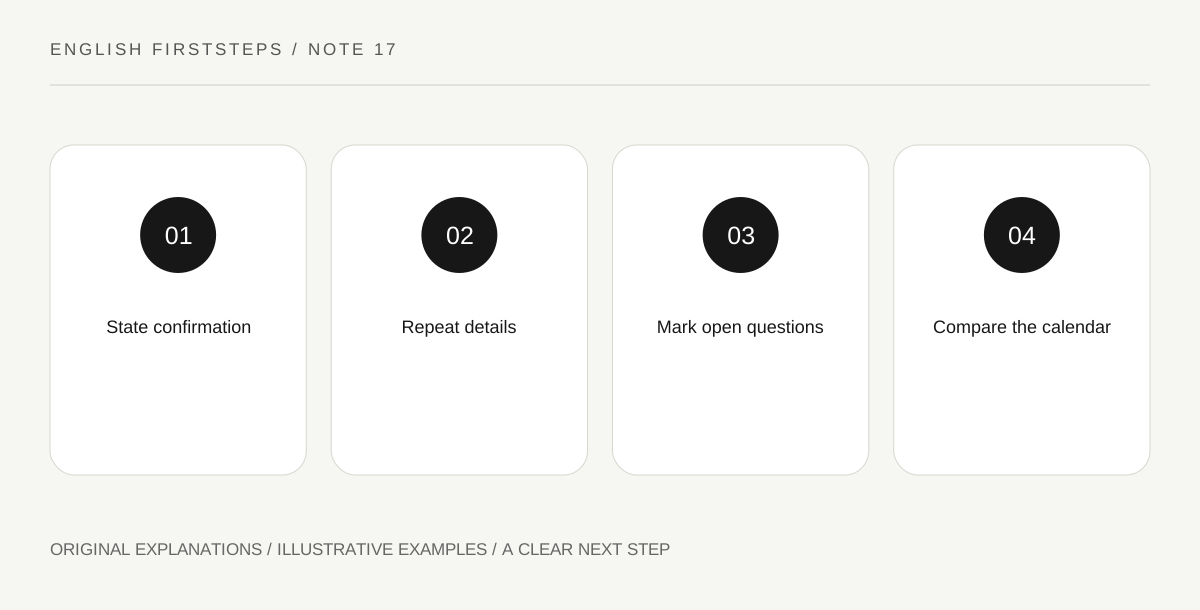
Original explanatory diagram. Read the full method and limitations below.
Name the purpose immediately
A subject such as Thursday study meeting gives the reader a useful clue. Begin with a suitable greeting and I’m writing to confirm our meeting. This establishes that you are checking an existing arrangement rather than asking the reader to choose among new options.
Use a fictional appointment and keep the subject specific enough to distinguish it from other messages. Meeting alone may be vague for someone with several appointments. A plain subject helps more than a long formal phrase that hides the topic or creates an unnecessary sense of urgency.
Repeat the complete time and place
State the day, actual date and clock time when ambiguity is possible. Spell out the month if numeric conventions might differ. Include the year for a distant appointment and the relevant time zone across locations. Accurate prepositions support the message, but factual details remain the main task.
Name the room, entrance or online method precisely. The office may be insufficient in a building with several offices. If a link or document is involved, use the established channel and check it before sending. Do not put real access credentials into a public language exercise.
Mark any unresolved question
Please let me know if any details are incorrect invites correction. If one item remains unsettled, ask about it: Could you confirm the room number? Do not call an appointment fully confirmed while leaving its date or location as an unmarked guess.
Make two versions of a practice email. One has all details agreed; another has an unknown room. A partner identifies which version needs a reply and what it should contain. This distinguishes informative confirmation from a request for new information and gives the reader a clear next action.
Finish briefly and check the calendar
A closing such as Best wishes followed by your name is enough for many ordinary emails. Formality depends on the setting, so follow an established communication style where appropriate. Avoid several ceremonial sentences that make a short factual message harder to scan.
Transfer the email into a blank calendar entry without looking at the original notes. Compare the result with the intended arrangement. This tests whether necessary information is present in a usable form. Correct facts and clear purpose matter more than an advanced-sounding greeting or a longer word count.
Illustrative confirmation email
Subject: Study meeting on 8 June. Hello Arun, I’m writing to confirm our study meeting on 8 June at 10 a.m. We will meet in Room Four at the community centre. Please let me know if any details are incorrect. Best wishes, Ella. These fictional details give the recipient a clear way to identify and correct a mismatch.
Practical checks
Optional checkboxes save only in this browser.
Questions that come up
Should every confirmation ask for a reply?
Not necessarily. If all details are agreed, inviting corrections may be enough. Ask for a reply when a required detail or the other person’s agreement is still missing, and state what information you need.
Can I write only a numeric date?
You can when the format is unambiguous to everyone. If conventions may differ, spell out the month and include the year when relevant. The aim is a shared date, not the shortest possible string.
References and scope
These sources support the factual background. Examples and exercises are original illustrative teaching material. References do not imply endorsement.
- British Council: Prepositions of time — At, in and on with clock times, dates and broader periods; weekend variation.
- British Council: A1 writing — Short messages, invitations, forms, instructions and simple emails.
- British Council: Appointment confirmation email — Clear basic appointment confirmation and relevant details.