Write a short message when you are running late
A useful delay message tells the other person what changed and what they can expect next. Keep the wording simple, distinguish an estimated arrival from a guaranteed one and say whether the meeting plan needs to change. Long explanations can hide the information the reader needs.
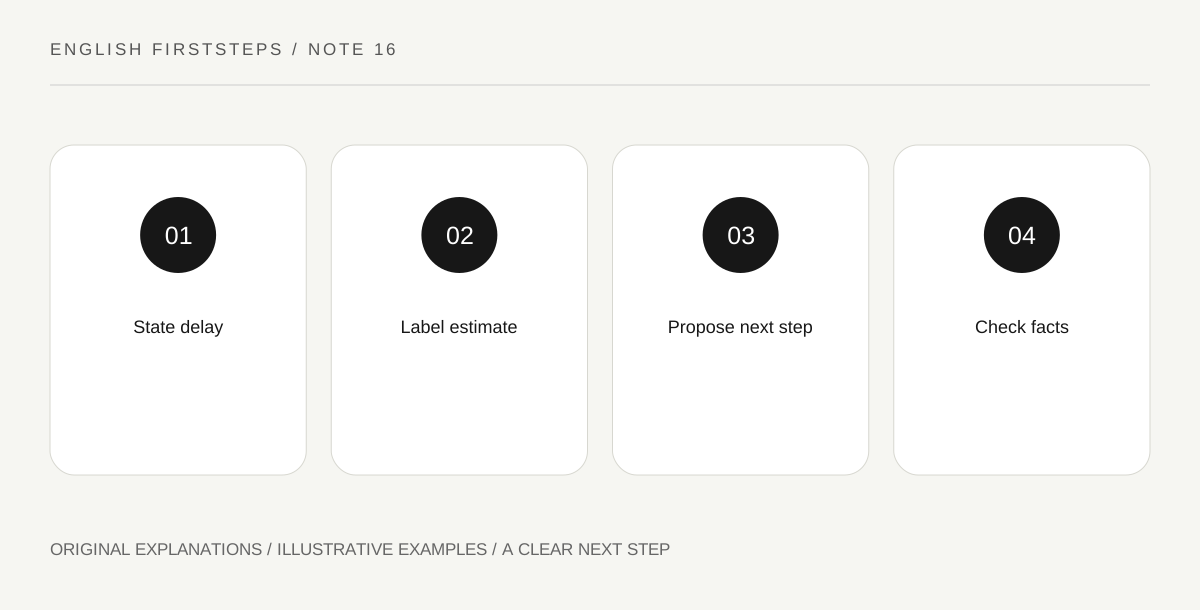
Original explanatory diagram. Read the full method and limitations below.
State the delay early
I’m running late gives the essential situation immediately. Sorry, I’m running about ten minutes late adds a brief apology and an estimate. You do not need to explain every part of the journey before the reader learns that you will miss the original time.
Write the main fact first. Then decide whether a short reason helps, such as The bus is delayed. Avoid invented certainty: if you do not know the cause or length of the delay, say what you know. A clear message can be honest without containing a complete account.
Separate duration from arrival time
Ten minutes late and I expect to arrive at 3:20 give related but different information. The first depends on the original appointment; the second names a clock time. Include enough context that the recipient does not need to reconstruct the schedule while deciding what to do.
Use about or I expect when the time is an estimate. If none is reliable, say I’m not sure when I’ll arrive and offer a sensible next update if possible. Do not turn a guess into a promise because a precise number makes the sentence look complete.
Give a practical next step
Please start without me or Can we meet at 3:30 instead? tells the reader what action you propose. A question leaves room for the other person’s constraints. They may have another appointment or be unable to wait, so a proposed change still needs agreement.
Give one partner a late-arrival card and another a limited-availability card. Write and answer messages. The reply may accept the delay, propose a shorter meeting or cancel. This makes the exercise a coordination task rather than a formula in which every reader waits indefinitely.
Proofread the facts before sending
Check the recipient, date, estimate and proposed new time. A message can be grammatically accurate while going to the wrong chat or naming the old hour. In actual travel, send updates only when appropriate and safe; a language drill is not a reason to type while moving unsafely.
Read as the recipient: Do I know whether to wait, start or reply? Remove details that do not help that decision. Informal messages can use contractions and short sentences. Abbreviations are optional; plain words are often clearer when the two people have different levels of English.
Illustrative delay text
Hi Lea, sorry, I’m running late. I expect to arrive at about 4:15, around fifteen minutes after our planned time. Can you still meet, or should we choose another day? This message states the change, labels the estimate and asks whether the revised plan works. It does not assume Lea can extend the meeting.
Practical checks
Optional checkboxes save only in this browser.
Questions that come up
Do I need a long apology?
Usually a brief apology and useful timing information help more. The appropriate tone depends on the relationship and impact, but a long explanation should not obscure the arrival estimate or requested change.
Can I use informal abbreviations?
You can with someone who understands them, but they are not required. In beginner writing and mixed-language communication, ordinary words often reduce ambiguity better than unfamiliar shortcuts. Choose clarity for the actual reader.
References and scope
These sources support the factual background. Examples and exercises are original illustrative teaching material. References do not imply endorsement.
- British Council: Prepositions of time — At, in and on with clock times, dates and broader periods; weekend variation.
- British Council: A1 writing — Short messages, invitations, forms, instructions and simple emails.
- British Council: A message to say you are late — Short delay messages with relevant timing information.