Write an invitation that is easy to accept or decline
An invitation needs an activity and enough practical information for the other person to decide. Friendly wording leaves room for no. Learn a simple invitation, a clear acceptance and a brief decline, then negotiate a missing detail without treating an interested reply as a settled plan.
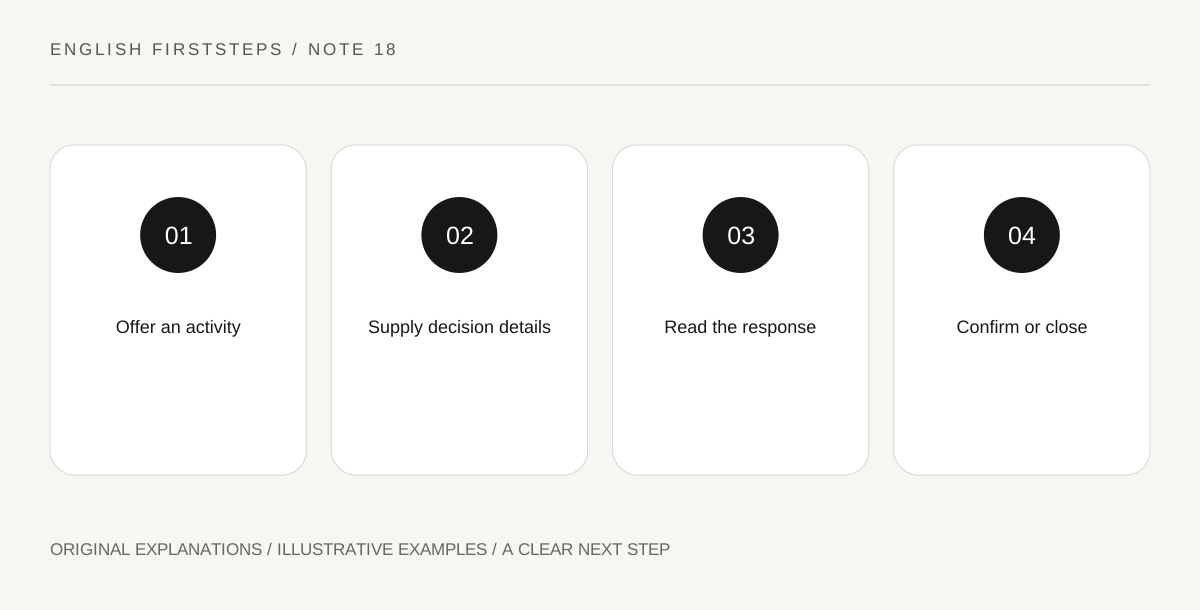
Original explanatory diagram. Read the full method and limitations below.
Offer a specific activity
Would you like to join me for a walk? and Do you want to study together? are useful invitations. The first is a common courteous form; the second can fit an informal setting. Choose wording appropriate to the relationship and keep the activity clear enough to evaluate.
Avoid saying only Are you free? when you can state the purpose. The other person may be free but uninterested in the activity or unable to manage its cost or duration. Giving the activity first lets them choose without committing to an unknown plan.
Include decision details
Add the proposed day, time and place, or identify what remains flexible. A walk near the library on Saturday afternoon is more useful than sometime soon when making an arrangement. If cost or travel matters, provide an accurate basis instead of assuming it is trivial for everyone.
Create an invitation card with activity, date, time and place. Leave one field open intentionally. The recipient asks about that field, and the sender answers. This teaches a targeted follow-up and avoids the impression that every possible logistical detail must appear in the first sentence.
Accept and confirm the plan
Yes, I’d like to or That sounds good expresses interest. If arrangements are complete, repeat a detail: See you at the library at two. Otherwise ask the remaining question. A friendly emoji or positive comment may show interest without establishing a precise commitment.
Give the accepting partner a conflicting time. They say they would like to join but propose another hour. The sender can agree or explain a limit. Acceptance becomes a conversation about a workable plan rather than a required yes followed by whatever details the sender chooses.
Decline briefly and clearly
Thanks for inviting me, but I can’t make it is a polite decline. You can offer another time if you want, but an alternative is optional. A refusal does not require private information or a fabricated excuse. The sender should treat it as an answer rather than an opening for pressure.
Exchange invitations and replies in writing. The reader marks whether the result is accepted, declined or undecided. If status is unclear, revise the message. Effective beginner writing communicates the decision and next step using simple vocabulary, without forcing every message to have the same cheerful ending.
Illustrative study invitation
Hi Rosa, would you like to study at the library on Saturday at 2 p.m.? We could work for an hour. Rosa replies, Thanks, I’d like to, but I’m only free after three. Could we meet at 3:30? The sender checks availability and confirms. Interest came before agreement on the time, and the final message resolves the difference.
Practical checks
Optional checkboxes save only in this browser.
Questions that come up
Must I give a reason when declining?
No. A courteous decline is enough in many situations. Share a reason or suggest another time if you wish, but you do not owe private details to make a refusal valid.
Can informal messages omit complete sentences?
Yes, especially between people who know each other. Preserve clear meaning. Short phrases can work well, while missing times or unclear references leave a plan unresolved. Check the message from the recipient’s perspective.
References and scope
These sources support the factual background. Examples and exercises are original illustrative teaching material. References do not imply endorsement.
- British Council: Prepositions of time — At, in and on with clock times, dates and broader periods; weekend variation.
- British Council: A1 speaking — Contextual speaking practice, introductions, suggestions and checking understanding.
- British Council: A1 writing — Short messages, invitations, forms, instructions and simple emails.