Write three instructions someone can actually follow
Simple instructions require clear actions, a useful order and an observable finish. Beginner English can do this without complex sentences. Choose a harmless everyday task, name the objects, and test whether another person can complete it using only the words you wrote.
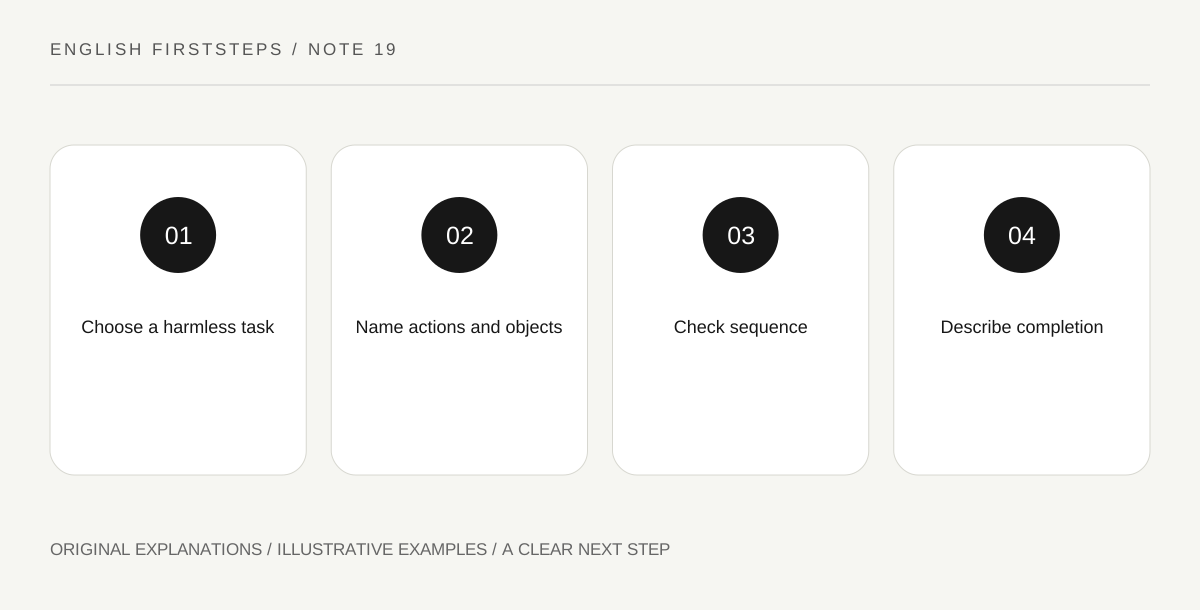
Original explanatory diagram. Read the full method and limitations below.
Begin with a visible action
Open the folder, choose the blue card and put it on the desk begin with base verbs. This instruction form often omits you because the reader is the person addressed. Choose an action the reader can carry out rather than a vague phrase such as Do the usual thing.
Use a low-risk task such as arranging paper cards or packing an empty stationery pouch. Avoid using a language drill to direct machinery, medication or tasks where misunderstanding could cause harm. The challenge should come from communicating the sequence, not from consequences of an error.
Name objects before using pronouns
Put the card in the envelope is clearer than Put it in there before the objects are established. Once the card and envelope are known, a pronoun reduces repetition, but it should have one obvious reference. Two similar objects make careless it especially confusing.
Set out a red card, blue card and envelope. Write one instruction for each card. Ask a partner to underline what each it would mean if you replaced a noun. If two answers are plausible, keep the noun. Clarity matters more than avoiding every repeated word.
Make the necessary order explicit
First, next and finally can show order. Numbered steps often do the same job, so both are not always necessary. Keep one main action in each step when a beginner must follow it precisely. A long sentence joined by and may hide several actions with different objects.
Rearrange your draft steps. If the result changes, make the sequence explicit. If two actions are independent, decide whether either can come first. Thinking about dependency helps instructions reflect the actual task rather than an arbitrary list, and reveals a missing prerequisite before someone attempts the task.
Describe the finished result
The blue card should be inside the envelope gives the reader a visible finish check. Instructions can be grammatical yet incomplete if the reader cannot tell whether the task is done. State the final arrangement or output in plain language.
Let someone follow the instructions without seeing a demonstration. Observe hesitation, then ask what the words seemed to mean. Revise the precise step that caused confusion. This is an illustrative classroom exercise, not a claim of professional usability testing. Repeat only when the changed wording needs a fresh check.
Illustrative paper-card task
First, put the blue card inside the empty envelope. Next, place the red card on top of the envelope. Finally, move the envelope and both cards onto the tray. The blue card should be inside, and the red card should remain outside. A partner follows the steps and compares the final arrangement with the written description.
Practical checks
Optional checkboxes save only in this browser.
Questions that come up
Is please required in every step?
No. Instructions commonly use direct action verbs, particularly in numbered procedures. A courteous introduction can establish tone. Clear, appropriate wording matters more than repeating please in each line, especially when a sequence must be easy to scan.
Should I use long sentences to sound advanced?
No. Short sentences often make sequences easier to follow. Add complexity only when it explains a necessary relationship, such as a condition. Check that the reader can still identify the object, action and result.
References and scope
These sources support the factual background. Examples and exercises are original illustrative teaching material. References do not imply endorsement.
- British Council: A1 writing — Short messages, invitations, forms, instructions and simple emails.
- British Council: Checking understanding — Requests for repetition and checks of understood information.