Turn a short recording into useful listening practice
A short recording can teach more than a long clip you barely understand. Set one purpose, compare your answer with the text and reuse a phrase in a new exchange. Keep recognition, reading support and independent recall as separate things you can actually observe.
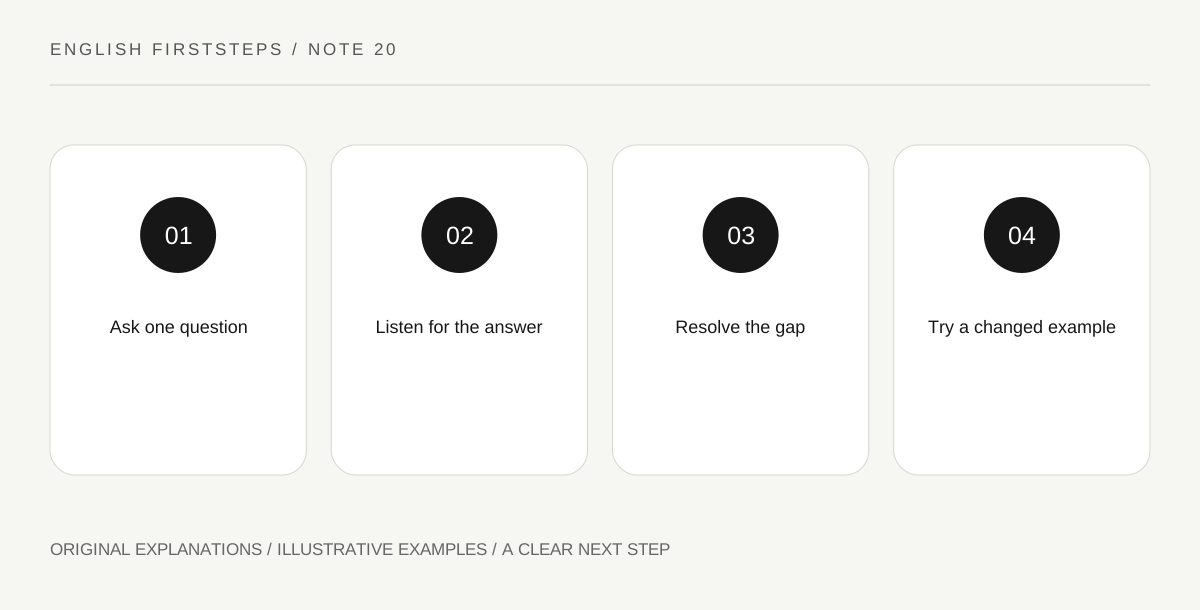
Original explanatory diagram. Read the full method and limitations below.
Set a manageable listening question
A clip about a café order, introduction or meeting time offers a limited situation and familiar vocabulary. Before playing it, ask one question: What drink is ordered? Where do they meet? What time does class start? A precise purpose makes listening more active than replaying until everything feels familiar.
Predict the type of answer without deciding it in advance. Expecting a time helps you notice relevant sounds; assuming three may make you ignore another number. Write an uncertainty mark when unsure instead of turning a partial impression into a confident transcription.
Replay for the missing part
On another pass, focus on the stretch containing the answer. You do not need to transcribe every word. If the problem is a number, isolate it; if it is a negative, listen to the complete phrase. Repetition needs a purpose rather than a fixed ritual or arbitrary count.
If the entire clip remains incomprehensible, choose easier material or more preparation support. Difficulty does not prove effectiveness. A manageable task distinguishes one missed word from an unknown structure and gives a realistic next step. Stop repeating when nothing new becomes clearer.
Use text to diagnose the gap
After attempting the task, inspect the relevant transcript. Was a word new, pronounced differently from expectation, or connected to surrounding words? Did you overlook not or a short helper? The answer indicates whether you need vocabulary, focused sound recognition or a clearer sentence pattern.
Listen while following the text, then hide it and try again. Reading with audio is useful support but does not demonstrate unaided listening. Mark the difference honestly. Add only a few useful phrases so the recording does not create an unmanageable list of every unfamiliar word.
Reuse a pattern with changed information
Ask a partner to say a similar sentence with a different item, person or time. If you understand only the original, you may have memorized the recording. A changed example checks whether the phrase or structure is available beyond one familiar voice and context.
Finish by speaking or writing one short sentence using the useful pattern. Return after a delay and retrieve it before opening notes. Progress is a specific improvement, such as recognizing a café follow-up, rather than a guarantee of rapid fluency. Choose the next practice target from the gap you actually observed.
Illustrative listening cycle
A learner listens for a meeting time and writes 4:15 with a question mark. The transcript shows 4:50. They compare fifteen and fifty in the sentence, replay without text, then hear a partner give three new times. They identify two correctly and note the remaining contrast for later. The notebook records the actual result rather than claiming the entire clip is mastered.
Practical checks
Optional checkboxes save only in this browser.
Questions that come up
Should I always avoid subtitles?
No. Text helps when used deliberately. Try a suitable short task without it, use the transcript to investigate a gap, then test again without text. You can then identify which support made understanding possible.
How many replays should I use?
There is no universal number. Replay while each pass has a clear question and yields information. If nothing changes, reduce difficulty, inspect the relevant text or move to focused practice on the specific problem instead of repeating indefinitely.
References and scope
These sources support the factual background. Examples and exercises are original illustrative teaching material. References do not imply endorsement.
- British Council: A1 speaking — Contextual speaking practice, introductions, suggestions and checking understanding.
- British Council: A1 listening — Elementary listening situations including cafés, directions, work and booking.
- British Council: Checking understanding — Requests for repetition and checks of understood information.