Confirm names, numbers and spelling without exposing real details
Names and digit strings demand precise listening even when the surrounding conversation is simple. Learn to ask for spelling, distinguish similar numbers and read a sequence back. Use fictional contact details for practice so accuracy work does not require publishing or sharing private information.
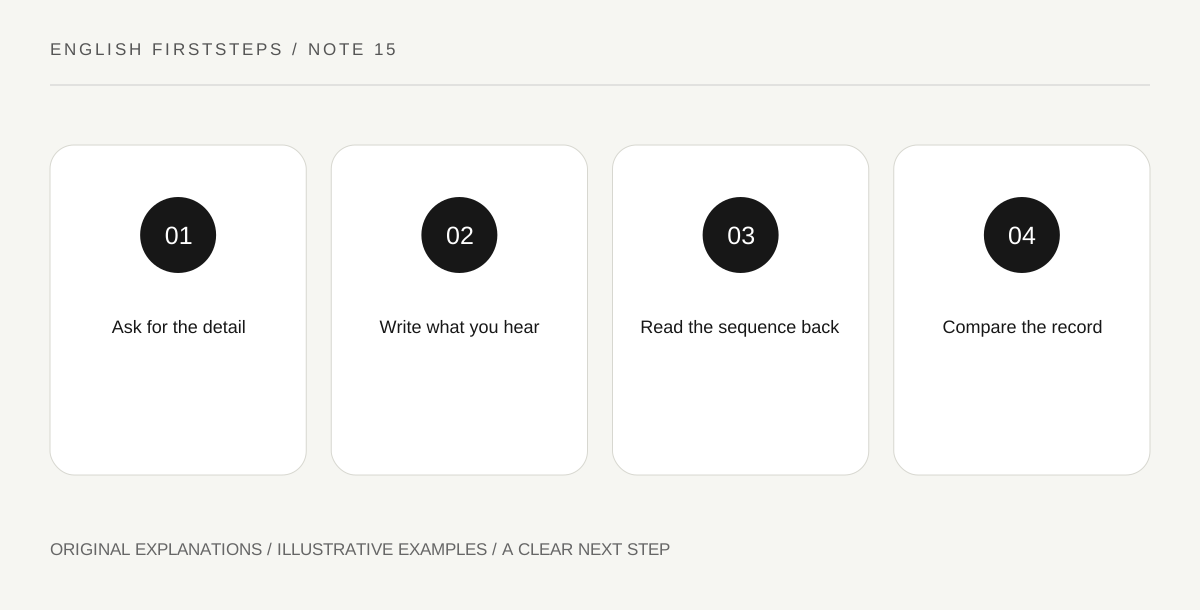
Original explanatory diagram. Read the full method and limitations below.
Ask for spelling rather than guessing
How do you spell your name? and Could you spell that, please? invite the speaker to give letters. A familiar-sounding name can have several spellings, so pronunciation alone may not establish the written form. Avoid changing an unfamiliar name into a familiar one without checking.
Practise the alphabet in mixed order rather than only as a song. A partner reads an invented name, then spells it. Write what you hear and compare. If one letter is unclear, ask about that position rather than request a complete restart automatically. This makes the repair more efficient.
Separate quantities from digit sequences
A price, age or quantity is normally read as a number. A phone number or access code is commonly read as digits, sometimes grouped. Zero may be called zero or oh in some contexts. Recognize alternatives and use an unambiguous form when giving important information.
Use fictional short codes that do not function as real credentials. Read 4058 digit by digit, then ask the listener to repeat it. Preserve order and repeated digits. Correct individual positions clearly rather than replacing the entire sequence with a different grouping halfway through.
Listen for teen and ty contrasts
Thirteen and thirty, fourteen and forty, and similar pairs can be confused. Their stress and final sounds differ, but speech varies by accent and context. Listen to complete examples from proficient speakers, then practise the pair in a clear sentence rather than relying on exaggerated isolated pronunciation.
Make a random list containing both members of several pairs. A partner reads an item and you write digits. Read your answer back: Did you say thirty? Showing digits can help when accuracy matters. The purpose is to establish the number, not win a speed test.
Confirm the record before using it
A read-back checks hearing and writing. Repeat the name, number or relevant part of an email address, then let the other person correct it. For actual contact information, confirm through an appropriate private channel and avoid displaying it in a public practice sheet or shared screenshot.
Use a fictional registration card with one missing letter and one missing digit. Ask only the questions needed to complete it, then compare the full card. Do not infer a missing character from a common pattern. A plausible address or code can still be the wrong one.
Illustrative registration card
A practice card shows the invented surname Bexon and code 4038. The listener writes Bexen and 4083. They ask for the surname’s final letters and read the code back digit by digit. The speaker corrects each mismatch. Comparing the complete fictional card confirms the repair without using anyone’s real phone number or account details.
Practical checks
Optional checkboxes save only in this browser.
Questions that come up
Should I use oh or zero?
Both occur when people read digit strings, depending on context and variety. Zero is often clearer when confusion with the letter O is possible. Ask for clarification rather than assume one form is universally required.
Must I practise with real personal information?
No. Fictional names and nonfunctional codes provide the same language challenge. Keep real contact details, passwords and account information out of public or casually shared practice materials, and use invented records for role-plays.
References and scope
These sources support the factual background. Examples and exercises are original illustrative teaching material. References do not imply endorsement.
- British Council: A1 speaking — Contextual speaking practice, introductions, suggestions and checking understanding.
- British Council: A1 listening — Elementary listening situations including cafés, directions, work and booking.
- British Council: A1 writing — Short messages, invitations, forms, instructions and simple emails.
- British Council: Checking understanding — Requests for repetition and checks of understood information.