Use in, on and at to explain where something is
Place prepositions express how you view a location: as an enclosed space, a surface or a point in an activity. Begin with visible objects and a simple map. The same place can take different prepositions when the intended meaning changes, so context matters more than a single translation.
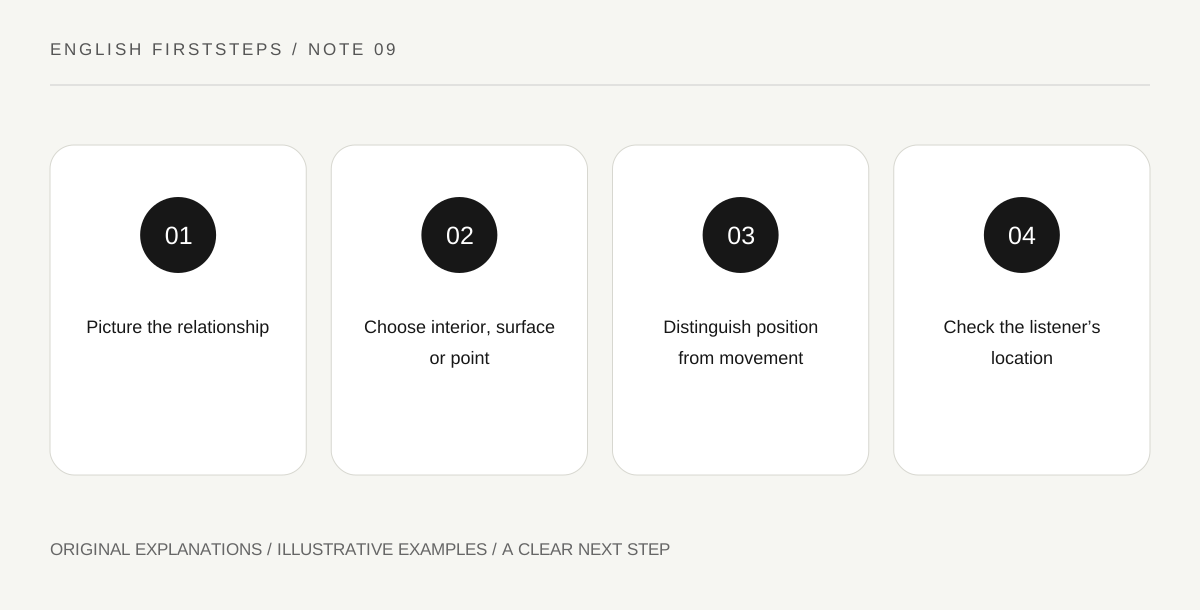
Original explanatory diagram. Read the full method and limitations below.
Use in for an interior or area
The keys are in the bag describes an interior. They are in the city describes a broader area. In does not require a literal sealed box, but the inside idea is a useful beginning. Point to a bag, room and city outline to make the relationship visible.
Hide a small object in one of several containers and describe its position. A partner identifies the container without opening all of them. Then move the object onto a container and compare the new sentence. Physical changes give the preposition a meaning that a translation list alone cannot provide.
Use on for a surface
The note is on the desk and the picture is on the wall describe contact with a surface. The surface need not be horizontal. On also appears in many conventional expressions, including transport and technology phrases, which need their own examples rather than a literal surface explanation every time.
For a room exercise, place cards on a table, wall and shelf. Say a sentence and ask the listener to point. Then let the listener move one card and describe the change. This tests whether you understand the relationship instead of associating one noun, such as table, permanently with on.
Use at for a point or activity location
At the entrance treats the entrance as a point where someone can meet you. At work describes an activity location. A person can be at the station while a more precise statement says they are in the station building. The speaker’s focus determines how the place is presented.
Use a map with a station outline and a marked entrance. Ask where the person is, then ask for a more exact meeting point. The first answer may be correct but insufficient. Learning to request precision is more useful than insisting that every location has exactly one permanent preposition.
Separate position from destination
I am at the library gives a current location. I am going to the library gives a destination. To and at are not interchangeable just because the same building appears after them. Decide whether the sentence describes where something is or where someone is moving before choosing the preposition.
Create a short information-gap task with one current-location marker and one destination arrow. A partner asks Where are you? and Where are you going? Answer each from the correct symbol. Then write a meeting instruction with a precise point, such as at the main entrance, so the listener can find the intended spot.
Illustrative missing-key description
A learner says, The keys are on the bag. The listener looks at the bag’s surface and finds nothing. The learner checks the picture and corrects the sentence: They’re in the bag, on the chair. Both relationships are needed: keys inside bag, bag supported by chair. One changed preposition produces a different search location.
Practical checks
Optional checkboxes save only in this browser.
Questions that come up
Can both at the station and in the station be correct?
Yes. At can identify the station as a general location, while in can emphasize being inside its building or area. Ask for a precise entrance or landmark if you are arranging a meeting.
Should I translate the preposition from my first language?
That can suggest a starting idea, but English patterns may differ. Learn the whole phrase with a picture or situation, and check conventional expressions instead of assuming a one-to-one translation.
References and scope
These sources support the factual background. Examples and exercises are original illustrative teaching material. References do not imply endorsement.
- British Council: There is and there are — Existence, singular and plural agreement, negatives and questions.
- British Council: Prepositions of place — In, on and at in elementary location descriptions.
- British Council: A1 listening — Elementary listening situations including cafés, directions, work and booking.