Choose at, in and on for a clear appointment time
Time prepositions become easier when you learn a few meaningful groups. At often marks clock times, on marks days and dates, and in marks months or broader periods. Use them to build an appointment message, while keeping the actual day and hour unambiguous.
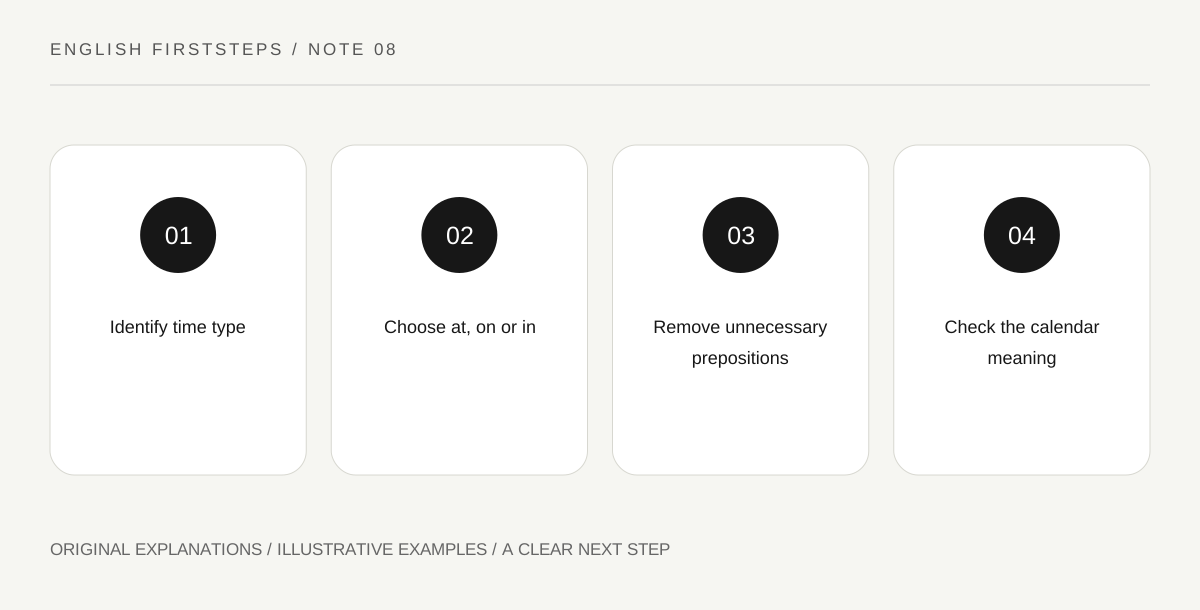
Original explanatory diagram. Read the full method and limitations below.
Use at with a clock time
At eight, at half past three and at 14:30 connect an event to a clock time. The preposition does not tell you whether eight means morning or evening, so add a.m., p.m. or a clear phrase when needed. A grammatically correct time can still be practically ambiguous.
Write three illustrative meeting times and read them aloud. A partner records the digits and part of day. Compare the records before adding other details. If the hour is correct but the part of day differs, solve that ambiguity rather than repeating the whole sentence louder.
Use on with days and dates
On Monday and on 12 June identify a day. On Monday morning keeps on because the phrase refers to a particular day’s morning. In the morning describes a broader part of day without naming a specific day. Learn these as contrasting examples rather than counting the number of words in the phrase.
Make two cards: in the morning and on Friday morning. Place each into a sentence about a class. Then change Friday to Tuesday without changing the preposition. This shows the useful pattern while preventing a mistaken rule that morning always takes in regardless of its context.
Use in with months and longer periods
In April, in winter and in 2028 refer to broader periods. In the afternoon is another common phrase. English also has fixed expressions and regional variation, so these groups are starting patterns rather than a promise that size alone determines every time preposition.
At the weekend is common in British English, while on the weekend or on weekends is common in American English. Choose a consistent model for your own practice and recognize the alternatives. A difference in regional convention does not necessarily mean someone has chosen the wrong grammar.
Know when no preposition is needed
Expressions such as today, tomorrow, next week and last Monday commonly appear without at, in or on. We meet tomorrow is clear; we meet on tomorrow is not the standard basic form. Learn these complete time expressions so you do not force a preposition into every sentence that mentions time.
For a final task, write a short appointment note containing a day, hour and location. Ask a partner to transfer it into a calendar. Check the resulting entry, including year or time zone if relevant. The calendar should reveal whether the message communicates the same appointment, not merely whether each preposition is individually correct.
Illustrative appointment wording
A learner writes, Can we meet on Thursday at 2 p.m.? The partner can only meet in the morning. They agree, Let’s meet on Friday morning at 10. The final note includes the actual date and the café name. Next Friday would not need on, while Friday morning does in this pattern. All dates and times are illustrative.
Practical checks
Optional checkboxes save only in this browser.
Questions that come up
Why is it on Monday morning but in the morning?
Monday morning identifies a particular day’s morning, so it follows the day pattern with on. The morning by itself follows the common part-of-day phrase in the morning. Learn the contrast as two useful chunks.
Is at the weekend the only correct form?
No. It is common in British English, while on the weekend and on weekends are common in American English. Consistency helps a beginner, but recognizing regional alternatives improves comprehension.
References and scope
These sources support the factual background. Examples and exercises are original illustrative teaching material. References do not imply endorsement.
- British Council: Prepositions of time — At, in and on with clock times, dates and broader periods; weekend variation.
- British Council: Appointment confirmation email — Clear basic appointment confirmation and relevant details.